Have you ever wondered why some yarns pill after one wash, while others stay soft for years? Or why a cotton dishcloth dries slowly, but a wool sock keeps your feet warm even when damp? The answer isn’t magic—it’s fiber science.
Every skein of yarn tells a story—not just through color and texture, but through its molecular structure, origin, and physical behavior. Whether it’s fluffy merino wool, crisp linen, shiny bamboo, or budget-friendly acrylic, each fiber has unique properties that directly impact how your finished project looks, feels, wears, and lasts.
Understanding these properties isn’t just for textile engineers—it’s a game-changer for anyone who crochets, knits, or sews. With this knowledge, you can choose the right yarn for the right project, avoid costly mistakes, and even predict how your handmade gift will hold up over time.
In this article, we’ll break down the science behind common natural and synthetic fibers, compare their performance in real-world use, and give you practical tips to make smarter yarn choices—every single time.
Ready to go beyond the label and understand what your yarn is really made of? Let’s unravel the science together.
Why Fiber Matters More Than You Think
When you’re standing in a yarn shop or scrolling online, it’s easy to choose based on color, price, or softness. But fiber content determines almost everything else: drape, elasticity, warmth, durability, care needs, and even environmental impact.
For example:
- A baby blanket in acrylic might be machine-washable but trap heat and cause irritation.
- The same blanket in cotton breathes well but becomes heavy and stiff when wet.
- In superwash merino, it’s soft, breathable, temperature-regulating—and machine-washable too.
The difference? The fiber.
Pro Tip: Always check the fiber content label—not just the brand name or “feel.” Two yarns that look identical can behave completely differently based on what they’re made of.
Natural Fibers: From Farm and Field to Your Hook
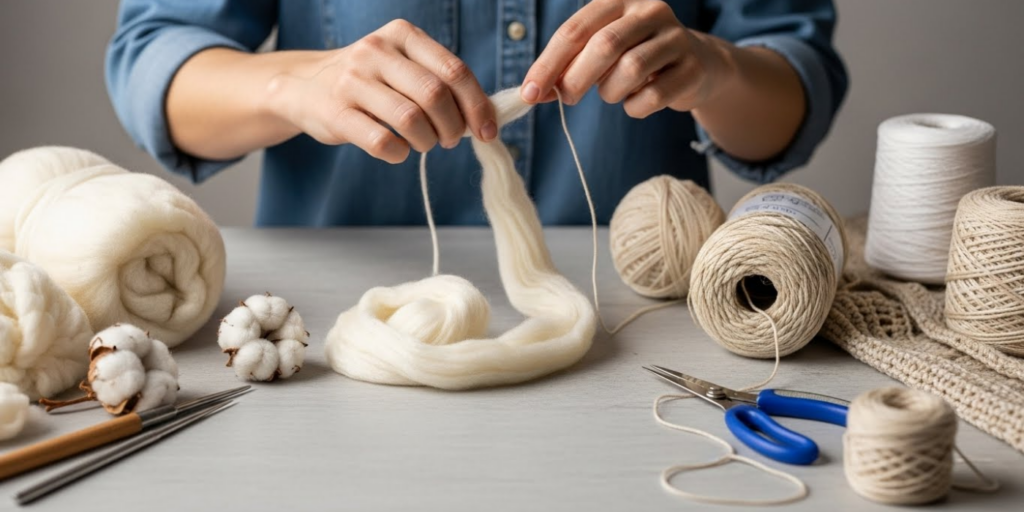
Natural fibers come from animals, plants, or insects. They’re biodegradable, breathable, and often luxuriously soft—but each has distinct strengths and limitations.
Wool (and Wool Blends)
Wool comes from sheep (like merino, Shetland, or Corriedale) and other animals (alpaca, cashmere, mohair). Its secret weapon? Crimp and scales.
The crimp gives wool incredible elasticity and memory—it bounces back after stretching, making it ideal for socks and hats. The microscopic scales on each fiber interlock when exposed to heat, moisture, and agitation—a process called felting. That’s why non-superwash wool shrinks in the dryer!
Best for: Warm garments, outerwear, textured stitches.
Care tip: Hand-wash in cold water unless labeled “superwash.”
Cotton
Cotton is smooth, strong, and absorbent—but lacks elasticity. It doesn’t stretch or recover well, which can make garments sag over time.
However, its absorbency makes it perfect for dishcloths, summer tops, and baby items (it wicks moisture away from skin). Mercerized cotton is treated to add sheen and strength—great for lace projects.
Best for: Household items, warm-weather wear, stitch definition.
Care tip: Expect some shrinkage; wash in cold water.
Linen & Hemp
These plant fibers are incredibly strong (linen is 30% stronger than cotton!) and get softer with every wash. They’re highly breathable and wick moisture beautifully—but they’re stiff at first and wrinkle easily.
Linen’s lack of stretch means it’s best for drapey garments (like tanks or shawls), not fitted items.
Best for: Summer wear, market bags, heirloom pieces.
Care tip: Embrace the wrinkles—they’re part of linen’s charm!
Synthetic Fibers: Engineered for Performance
Synthetics like acrylic, nylon, and polyester are human-made from petrochemicals. While not biodegradable, they offer consistency, affordability, and easy care.
Acrylic
The most common budget yarn, acrylic is soft, lightweight, and machine-washable. Modern versions mimic wool or cotton quite well.
However, it doesn’t breathe, traps heat, and pills easily with friction (like underarms or sock heels). Cheap acrylic can also feel “plasticky” and melt if exposed to high heat.
Best for: Practice projects, charity blankets, accessories (hats, scarves).
Care tip: Wash on gentle; avoid high dryer heat.
Nylon (Polyamide)
Often blended with other fibers (especially wool for socks), nylon adds strength, elasticity, and abrasion resistance. It’s what makes sock yarns durable.
It’s also quick-drying and resilient—but not breathable on its own.
Best for: Sock heels/toes, stitch markers, durable trims.
Fun fact: Most “superwash” wool contains a thin nylon coating to prevent felting.
Polyester & Bamboo (Rayon)
Polyester is strong and colorfast but feels stiff and doesn’t absorb moisture.
Bamboo (technically rayon/viscose) is silky, drapey, and absorbent—but weak when wet and prone to stretching.
Both are often blended to add sheen or drape—but rarely used alone for full garments.
Blends: The Best of Both Worlds?
Most commercial yarns are blends—and for good reason. Combining fibers balances their weaknesses and enhances strengths.
Examples:
- Wool + Nylon (80/20): Softness + durability = perfect sock yarn.
- Cotton + Acrylic (50/50): Breathability + affordability + less shrinkage.
- Alpaca + Silk: Drape + sheen + warmth without itch.
Pro Strategy: Look for blends that solve a specific problem. Need a washable baby blanket? Choose cotton-bamboo-acrylic. Want cozy but non-itchy? Try merino-cashmere-nylon.
Watch out for: “Mystery blends” with vague labels like “novelty fiber.” When in doubt, swatch and wash it!
Performance Comparison: Real-World Behavior
Let’s see how fibers stack up in everyday use:
| Fiber | Warmth | Breathability | Stretch | Durability | Care Ease | Eco-Impact |
|---|---|---|---|---|---|---|
| Wool | ★★★★★ | ★★★★☆ | ★★★★☆ | ★★★★☆ | ★★☆☆☆ | ★★★★☆ |
| Cotton | ★★☆☆☆ | ★★★★☆ | ★☆☆☆☆ | ★★★☆☆ | ★★★★☆ | ★★★☆☆ |
| Linen | ★☆☆☆☆ | ★★★★★ | ★☆☆☆☆ | ★★★★★ | ★★★☆☆ | ★★★★☆ |
| Acrylic | ★★★★☆ | ★★☆☆☆ | ★★★☆☆ | ★★☆☆☆ | ★★★★★ | ★☆☆☆☆ |
| Nylon | ★★☆☆☆ | ★★☆☆☆ | ★★★★☆ | ★★★★★ | ★★★★☆ | ★★☆☆☆ |
Note: Superwash treatments improve care ease for wool but reduce biodegradability.
Takeaway: There’s no “best” fiber—only the best fiber for your project’s needs.
Choosing the Right Yarn: A Practical Decision Tree
Next time you’re yarn shopping, ask yourself:
- What is this item for?
- Baby? → Soft, hypoallergenic, washable (cotton, superwash merino).
- Winter hat? → Warm, elastic, wind-resistant (wool, alpaca).
- Dishcloth? → Absorbent, strong, heat-tolerant (cotton, linen).
- Who is it for?
- Sensitive skin? Avoid coarse wool or cheap acrylic.
- Active lifestyle? Prioritize durability (nylon blends).
- How will it be cared for?
- Gift for a busy parent? Choose machine-washable fibers.
- Heirloom piece? Opt for natural, long-lasting fibers like linen or wool.
- What’s your budget?
- Splurge on natural fibers for items worn close to skin.
- Save synthetics for decor or short-term use.
The Environmental Angle: Sustainability Matters
Natural fibers are biodegradable but often require lots of water, land, or chemicals (e.g., conventional cotton uses 2,700 liters of water per T-shirt!). Synthetics last forever—but shed microplastics in the wash.
Eco-smart choices:
- Organic cotton or Tencel™ (sustainably sourced wood pulp).
- Recycled fibers (many brands now offer recycled cotton or polyester).
- Local wool (supports small farms and reduces shipping emissions).
Remember: The most sustainable yarn is the one already in your stash—so use it all!
Final Thought: Yarn Is More Than String—It’s Material Intelligence
Every time you choose a yarn, you’re making a decision rooted in physics, chemistry, and biology. Understanding fiber properties turns you from a passive user into an informed designer—someone who can predict how a stitch will drape, how a sock will wear, or how a blanket will age.
That’s not just crafting. That’s applied science with soul.
Conclusion: Choose Wisely, Create Confidently
In this guide, you’ve learned how fiber origin and structure drive yarn performance—from warmth and stretch to care needs and environmental impact. You now know:
- The strengths and weaknesses of natural vs. synthetic fibers
- How blends solve real-world problems
- A practical framework for choosing yarn based on use, user, and care
- Why sustainability starts with smart fiber choices
Armed with this knowledge, you’ll spend less time regretting “wrong” yarn choices and more time creating pieces that look beautiful, feel great, and last.
So the next time you pick up a skein, take a moment to read the label—not just the color name, but the fiber story inside. Your projects (and the planet) will thank you.
What’s one yarn mistake you’ve learned from? Or which fiber surprised you the most once you understood its science?
Share your experiences in the comments—we’re all students of the stitch! 🧶🔬

Maria Santos is a dedicated crochet and knitting enthusiast who finds joy in turning simple strands of yarn into meaningful, handmade art. With a natural eye for detail and a deep love for fiber crafts, she brings warmth, creativity, and years of personal experience to every project. Maria is inspired by the stories woven into each stitch and loves sharing that passion with others.