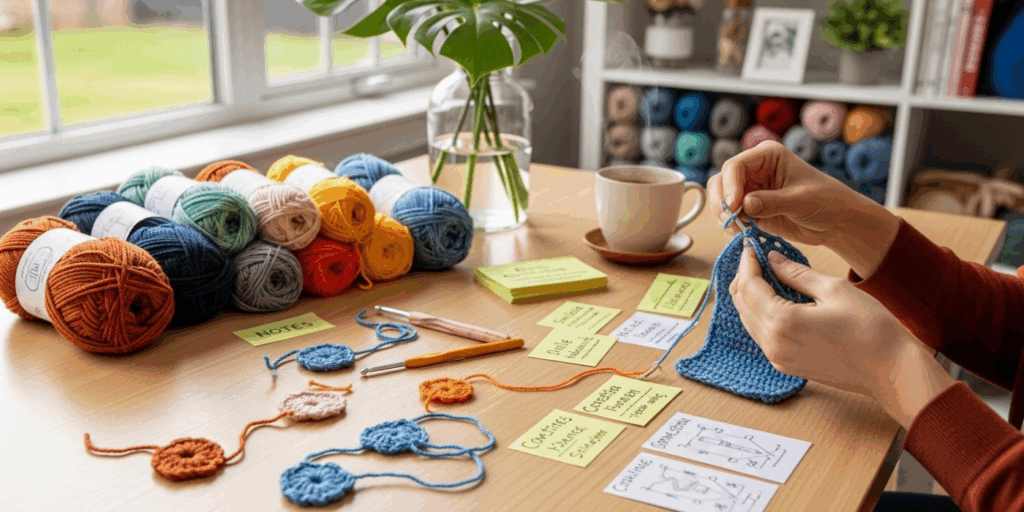
You’ve got your hook, your yarn, your favorite cozy blanket, and the YouTube tutorial open on your laptop. You’re ready to make your first scarf—or maybe even a cute amigurumi unicorn. But then… uh-oh. Your edges are wavy. Your stitches are uneven. Your project looks more like a lopsided pancake than a cozy masterpiece.
Don’t panic.
You’re not alone. In fact, every experienced crocheter has been right where you are—staring at a tangled mess, wondering if they’ll ever get this right. The truth? Crochet mistakes aren’t failures. They’re just part of the learning curve. And the good news? Most of them are quick, easy, and totally fixable—even if you’ve already gone a few rows deep.
In this guide, we’ll walk through the five most common beginner crochet errors—the ones that make you want to rip it all out and start over—and give you simple, practical fixes you can use today. No jargon. No overwhelm. Just clear, friendly advice that turns frustration into progress. Whether you’re making a blanket, a hat, or your first granny square, these tips will save you time, stress, and maybe even a whole skein of yarn.
By the end, you won’t just know how to fix mistakes—you’ll feel confident enough to spot them before they happen. And that? That’s the real magic of crochet.
Mistake #1: Uneven Tension – Your Stitches Are Too Tight (or Too Loose)
If your work looks like a bumpy road or a saggy hammock, you’re probably dealing with tension issues. This is the #1 complaint among beginners—and honestly, it’s also the most common reason people quit crochet early.
Here’s the thing: tension isn’t about strength. It’s about rhythm. When you hold the yarn too tightly, your stitches become stiff, hard to work into, and your project shrinks. Too loose? Your fabric gaps, your edges curl, and your hook slips right out.
I remember my first attempt at a dishcloth. I was so focused on “doing it right” that I gripped the yarn like I was holding onto a life raft. The result? A stiff, tiny square that looked more like a coaster for a teacup than a real dishcloth.
The Fix:
- Try the “Relax & Breathe” Method. Before each stitch, take a slow breath. As you exhale, let your fingers relax slightly around the yarn. Think of it like holding a baby bird—firm enough to keep it safe, gentle enough not to hurt it.
- Use a Larger Hook (Temporarily). If your tension is too tight, switching up one or two hook sizes bigger can give you breathing room while you practice. Once you feel more comfortable, go back to your original size.
- Practice with Scrap Yarn. Make a 6-inch swatch just for fun. Don’t worry about the pattern—just focus on keeping your loops consistent. Do this for 10 minutes a day for a week, and you’ll notice a huge difference.
Tension improves with time, not perfection. You’re not supposed to get it right on day one. You’re supposed to get better with every stitch.
Mistake #2: Skipping or Adding Stitches Accidentally (The “Mystery Stitch” Problem)
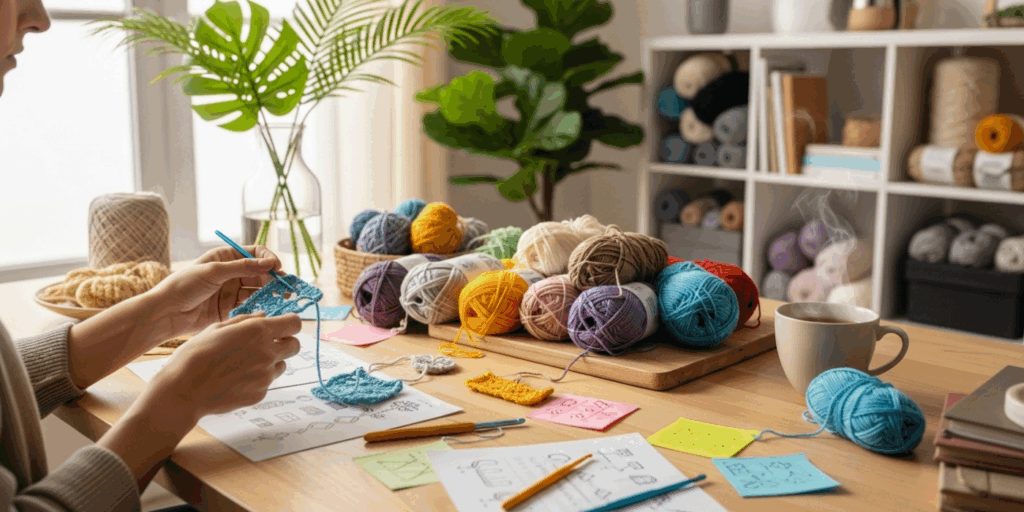
You start a row with 20 stitches. You finish it… and now you have 22. Or 18. You count again. Still wrong. You rip it out. You start over. And it happens again.
This is the crochet version of “Where did my socks go?”—except it’s ruining your project.
Most of the time, this happens because you’re missing the first or last stitch of the row. Beginners often forget that the turning chain (the chain you make at the beginning of a new row) sometimes counts as a stitch—sometimes it doesn’t. And if you’re counting your stitches like you’re counting sheep, you might accidentally skip the very first stitch after the chain, thinking it’s “just the chain.”
The Fix:
- Use Stitch Markers. Seriously. Grab a safety pin, a scrap of contrasting yarn, or even a paper clip. Clip it into the first stitch of each row. When you finish, you’ll know exactly where to start the next one.
- Count as You Go. Don’t wait until the end. After every 5 stitches, pause and count: “One, two, three, four, five…” It slows you down, but it builds accuracy.
- Know Your Pattern. If the pattern says, “Chain 2, turn—this counts as your first stitch,” then your first actual stitch goes into the second stitch from the hook. If it says, “Chain 2, turn—do not count as a stitch,” then your first stitch goes into the very first stitch.
I once made a baby blanket that was 3 inches wider on one side because I kept adding a stitch at the end. It was cute… but not exactly baby-sized. Lesson learned.
Pro tip: If you’re unsure, take a photo of your work after each row. It’s easier to spot extra or missing stitches when you’re looking at a picture than when you’re staring at your hands.
Mistake #3: Crocheting Too Fast (And Losing Your Place)
We live in a world of instant gratification. We want results now. And that’s great—until you’re trying to crochet while scrolling TikTok, listening to a podcast, and answering texts.
When you rush, your brain doesn’t keep up with your hands. You skip stitches. You miscount. You twist your chain. You end up with something that looks like abstract art… and not the kind you’d hang on your wall.
I used to crochet while watching Netflix. I’d get to the dramatic part of the show, lean back, and—bam—accidentally made a whole row of double crochets where I meant to do single crochets. My scarf ended up looking like a zigzag lightning bolt.
The Fix:
- Slow Down. Seriously. Set a timer for 15 minutes. Focus only on your crochet. No distractions. Just you, your hook, and your yarn.
- Use a Rhythm. Say it out loud: “In, yarn over, pull through, yarn over, pull through two.” It’s like a little chant. It keeps your hands steady and your mind present.
- Choose the Right Time. Crochet when you’re calm—not when you’re tired, stressed, or multitasking. Even 10 minutes of focused work is better than an hour of frantic, mistake-filled stitching.
Think of it like learning to drive. You don’t start on the highway. You practice in an empty parking lot. Crochet is the same. Slow, intentional practice builds muscle memory—and fewer mistakes.
Mistake #4: Not Understanding How to Read Your Pattern (And Getting Lost)
Patterns can feel like a foreign language. “Sc in next 3 sts, hdc in next, dc in next 2, skip 1, repeat.” What does that even mean?
Most beginners try to follow patterns like they’re reading a novel—left to right, word by word. But crochet patterns are more like a recipe with shortcuts. You need to understand the structure, not just the words.
For example, “Repeat from * to end” means go back to the asterisk and do that section again. If you miss that, you’re doing the whole thing over and over—and your project gets way too big.
The Fix:
- Highlight or Circle Key Parts. Use a yellow marker on your printed pattern: circle “repeat,” underline “turn,” highlight “beginning chain.” Visual cues help your brain process faster.
- Write It Out in Your Own Words. Translate the pattern into plain English. “Chain 10. Row 1: Single crochet in second chain from hook, then one in each chain across. Chain 1, turn.” Now it’s clear.
- Use Free Online Tools. Websites like Crochet Pattern Wizard or apps like “Crochet Buddy” let you input patterns and automatically highlight repeats and stitch counts.
I once followed a pattern for a hat that said “increase every other row.” I thought that meant “do an increase in every row.” Result? A hat that fit a toddler… and I was an adult. I spent three days unraveling it. Don’t be me.
Remember: Patterns aren’t puzzles to solve—they’re instructions to follow. Take your time. Read it twice. Then do it once.
Mistake #5: Ripping Out Too Soon (And Losing Your Confidence)
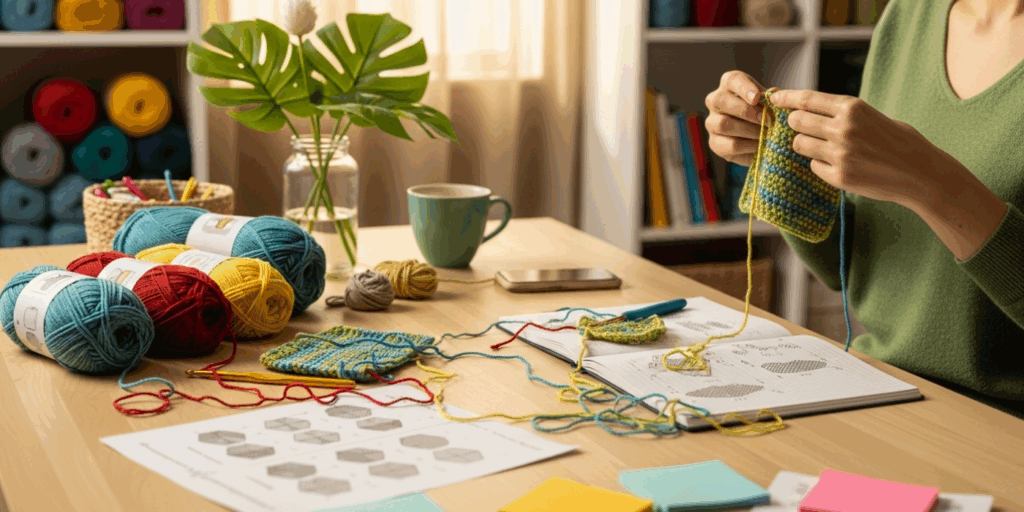
This one hurts.
You’ve worked for hours. You’re proud. You’re almost done. Then you notice a tiny mistake—a skipped stitch, a twisted chain, a slightly uneven edge.
And you panic.
You grab your scissors. You snip. You unravel. And suddenly, your beautiful project is a tangled mess on the floor. You stare at it. You sigh. You put the yarn away… and you don’t pick it up again for weeks.
Sound familiar?
Here’s the truth: Most mistakes aren’t as bad as they look. And ripping everything out? That’s often the biggest mistake of all.
I once made a blanket where the first 10 rows were all single crochet… but I accidentally switched to double crochet on row 11. It was noticeable. I wanted to quit. But instead, I kept going. I turned it into a striped design. Now it’s one of my favorite blankets—because it has character.
The Fix:
- Ask Yourself: “Will Anyone Else Notice?” Chances are, no. Even experienced crocheters have imperfect projects. The ones you see on Instagram? They’ve ripped out and restarted dozens of times.
- Learn to Fix It Without Ripping. Use a latch hook or a small crochet hook to carefully pull out just the bad stitches. You don’t need to start over.
- Celebrate Progress, Not Perfection. Did you finish a row? Good. Did you fix a mistake? Even better. That’s growth.
Crochet isn’t about flawless projects. It’s about persistence. It’s about showing up, even when it’s messy.
Your first project doesn’t need to be museum-worthy. It just needs to be yours.
Bonus Tip: How to Prevent Mistakes Before They Happen
You’ve learned how to fix mistakes. Now let’s talk about avoiding them in the first place.
Here are three simple habits that make a huge difference:
- Always Chain One More Than You Think You Need. Especially when starting a new row. It’s easier to remove an extra chain than to struggle with a tight edge.
- Keep a Notebook. Jot down what hook size, yarn weight, and stitch count you used for each project. You’ll thank yourself later.
- Join a Crochet Community. Reddit’s r/crochet, Facebook groups, or even local craft circles are full of people who’ve been where you are. Ask questions. Share your work. You’ll get support—and maybe even a free pattern.
I started a little journal when I began crocheting. Now, it’s full of notes like: “Used worsted weight yarn, size H hook—perfect for scarves!” and “Don’t forget to count stitches on row 7. I messed it up twice.” It’s not fancy. But it’s mine. And it’s helped me grow.
You’re Not Behind. You’re Just Getting Started.
Let’s be real: Crochet isn’t about speed. It’s not about perfection. It’s not even about making the prettiest blanket on Pinterest.
It’s about the quiet moments. The way your hands find a rhythm. The way your mind quiets down when you’re focused on loops and yarn. The pride you feel when you look at something you made with your own two hands—even if it’s a little lopsided.
Every crocheter you admire? They started with a wobbly chain. They had rows that looked like snakes. They ripped out projects. They cried. They laughed. And then they kept going.
So if you’re reading this right now, holding a half-finished project, wondering if you should give up…
Don’t.
You’re not failing. You’re learning.
And every mistake you fix? That’s not a setback. That’s a step forward.
Maybe your next scarf won’t be perfect. But it’ll be better than the last one. And the one after that? Even better.
That’s the beauty of crochet. It doesn’t demand perfection. It rewards patience.
Your Turn: What’s Your Biggest Crochet Mistake?
I’d love to hear from you.
What’s the most common mistake you’ve made? Was it a tangled mess? A miscounted row? A project you almost quit?
Drop a comment below—share your story. You might just help someone else feel less alone.
And if you found this guide helpful? Share it with a friend who’s just starting out. Because no one should feel discouraged by a few wonky stitches.
Now go pick up your hook.
Take a breath.
And make one more stitch.
You’ve got this. 💛
Maria Santos is a dedicated crochet and knitting enthusiast who finds joy in turning simple strands of yarn into meaningful, handmade art. With a natural eye for detail and a deep love for fiber crafts, she brings warmth, creativity, and years of personal experience to every project. Maria is inspired by the stories woven into each stitch and loves sharing that passion with others.