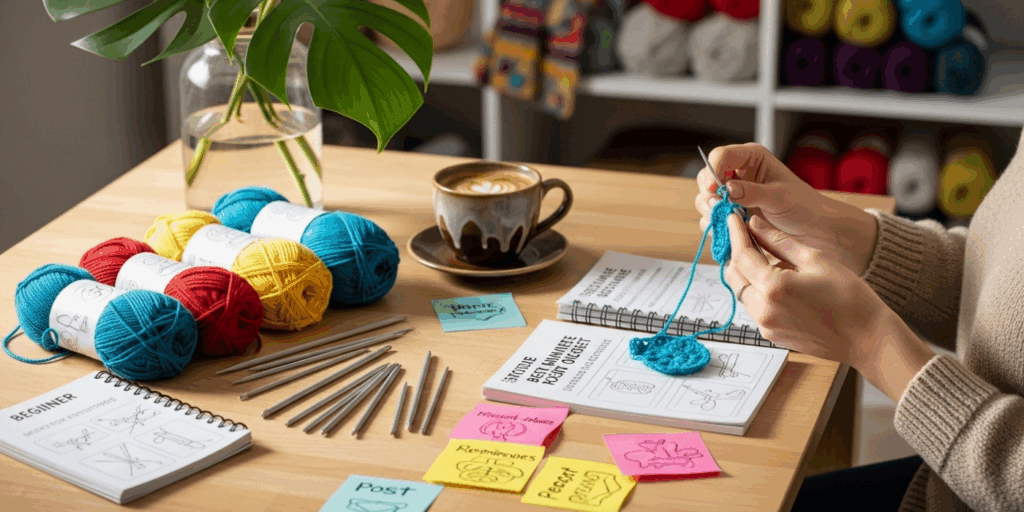
Imagine this: You’re curled up on your favorite armchair, a soft blanket draped over your lap, sipping tea as the afternoon sun filters through the window. The rhythm of your hands moving, loop by loop, creates something warm, beautiful, and entirely yours. No screen. No noise. Just yarn, hook, and quiet joy.
That’s the magic of crochet—and you don’t need to be an artist, a craft expert, or even remotely “handy” to start. In fact, some of the most beautiful pieces ever made began with a complete beginner fumbling through their first chain stitch.
If you’ve ever stared at a crocheted scarf, hat, or amigurumi toy and thought, “I wish I could make that,” this guide is your gentle, no-pressure invitation to begin. No intimidating jargon. No overwhelming patterns. Just a clear, friendly roadmap to help you turn a ball of yarn into your next favorite hobby.
In this article, we’ll walk through everything you need to know to start crocheting today: the basic tools you actually need (spoiler: you probably already have some), the first stitches that will feel like magic after just 10 minutes, how to avoid the most common beginner mistakes, and why this simple craft can actually improve your mental well-being. We’ll also share real-life stories of people who started with zero experience—and now make gifts for loved ones, sell their creations, or simply find peace in every stitch.
By the end, you won’t just know how to crochet—you’ll feel excited to pick up your hook and try. Let’s begin.
Why Crochet? More Than Just a Hobby
Let’s be honest: life is busy. Between work, family, scrolling, and endless to-do lists, finding a moment of calm can feel impossible. That’s where crochet steps in—not as another task to add to your plate, but as a quiet, grounding ritual.
Studies from the Journal of Health Psychology show that repetitive, rhythmic activities like knitting and crocheting can lower cortisol levels (the stress hormone) and increase serotonin production—essentially, they’re natural mood boosters. Think of it like meditation, but with a cozy outcome. One woman I spoke to, Maria, 58, started crocheting after retiring. “I felt lost,” she told me. “Then I made my first scarf. Not perfect. But it was mine. And for the first time in months, I didn’t think about anything else for an hour.”
Crochet doesn’t demand perfection. It rewards patience. And unlike other crafts that require expensive equipment or a dedicated workspace, all you need is a hook and some yarn. You can do it on the bus, during commercial breaks, or while listening to your favorite podcast.
Plus, the results? Instant gratification. While a painting might take weeks, your first crocheted coaster? Done in under 30 minutes. That quick win builds confidence. And confidence? That’s the secret ingredient to sticking with anything.
This isn’t just about making things. It’s about reclaiming time, quiet, and creativity in a world that rarely gives you permission to slow down. And the best part? You’re not alone. Over 25 million people in the U.S. now crochet regularly, according to the Craft Yarn Council. It’s not a niche hobby—it’s a movement of people choosing calm over chaos.
So if you’ve been curious, now’s the time. You’re not starting a project. You’re starting a practice. And it’s waiting for you—with open arms and a soft, colorful yarn.
Your First Crochet Kit: What You Actually Need (No Overbuying!)
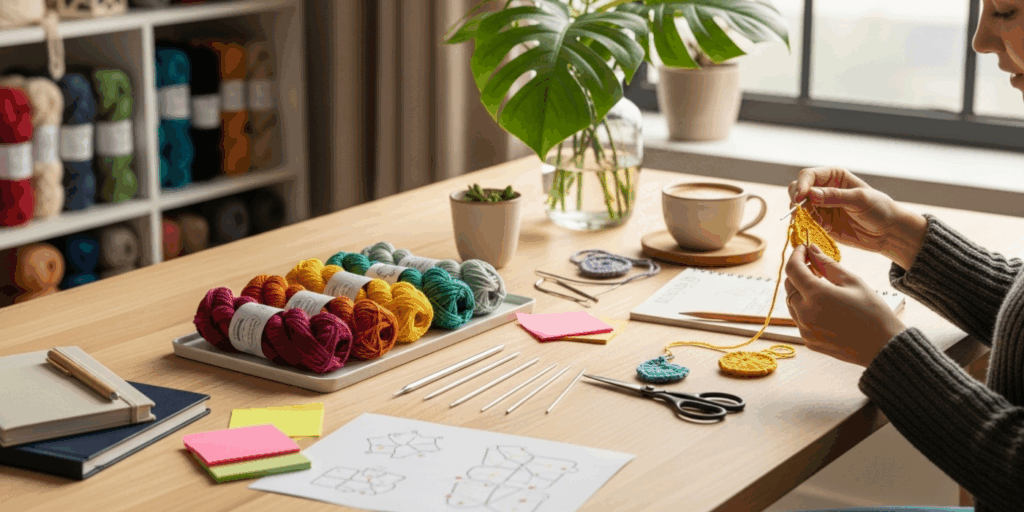
Let’s cut through the noise: you don’t need a $100 starter kit with 20 hooks and 50 colors of yarn. Seriously. You can start with less than $15—and you might already have most of it.
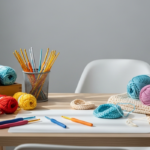
Here’s your real beginner checklist:
- One crochet hook: Start with a size H/8 (5mm). It’s the Goldilocks size—big enough to see what you’re doing, small enough to handle easily. Aluminum or ergonomic plastic hooks are ideal for beginners.
- One ball of medium-weight yarn (Category 4): Look for “worsted weight” or “aran.” Choose a light color (like beige, cream, or soft gray)—dark colors make it hard to see your stitches. Acrylic yarn is affordable, easy to work with, and machine washable.
- Scissors: Any pair you have at home.
- Tapestry needle (optional at first): You’ll need this later to weave in ends, but you can skip it for now.
That’s it. No rulers. No stitch markers. No fancy patterns. Just you, your hook, and a ball of yarn.
I know what you’re thinking: “But I’ve seen videos with 17 different hooks and specialty yarns!” Yes. And those are for advanced projects. As a beginner, your goal isn’t to collect tools—it’s to learn the feel of the yarn, the motion of the hook, and the rhythm of the stitch.
Pro tip: Avoid novelty yarns (like fluffy, metallic, or super thick bouclé) for now. They look pretty, but they hide your stitches and make learning frustrating. Stick with smooth, solid-color acrylic. It’s forgiving. It’s kind to your fingers. And it’s cheap enough that if you make a mistake? No big deal.
Want to test the waters before spending money? Check your local thrift store. You’d be amazed how many people donate unused yarn and hooks. I once found a perfect H hook and three balls of yarn for $2.50. That’s not a craft investment—that’s a gift.
Your first project doesn’t need to be perfect. It just needs to be yours.
The First Two Stitches: Chain and Single Crochet (You Can Do This!)
Okay, let’s get your hands moving.
The two stitches you need to master right now? The chain stitch (ch) and the single crochet (sc). Master these, and you’ve unlocked 80% of beginner patterns.
Step 1: Make a Slip Knot
Hold the yarn tail in your left hand. Loop the working end over your fingers, pull a small loop through, and gently tighten it around your hook. This is your starting point. Think of it like tying the first knot in a shoelace.
Step 2: Chain Stitch (ch)
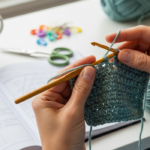
Hold the hook like a pencil. Yarn over (wrap the yarn over the hook from back to front). Pull it through the loop on your hook. That’s one chain. Repeat. Make 10–15 chains. Don’t worry if they’re uneven. They’re supposed to be a little wobbly at first.
Why this matters: The chain stitch is the foundation of nearly every crochet project. It’s your “canvas.”
Step 3: Single Crochet (sc)
Insert your hook into the second chain from the hook (yes, skip the first one!). Yarn over. Pull up a loop (now you have two loops on your hook). Yarn over again. Pull through both loops. One single crochet done!
Repeat across the row. You’ll feel a satisfying little click with each stitch. It’s like knitting with your fingers—but easier.
Try this: Make a 10-chain foundation, then single crochet across. You’ve just made your first rectangle. Congratulations. That’s a coaster. That’s a potholder. That’s your first finished piece.
Common mistake? Pulling too tight. Your stitches should feel snug, but not tense. Imagine you’re holding a baby bird—firm enough to keep it safe, gentle enough not to hurt it.
Practice this for 10 minutes a day for three days. You’ll notice your hands starting to move without thinking. That’s muscle memory forming. And that’s when the magic begins.
Why Crochet Is the Perfect Mindful Activity (Science + Soul)
Let’s talk about what’s really happening when you crochet—not just with your hands, but with your mind.
Every loop you pull, every stitch you make, requires focus. But not the kind of focus that drains you. The kind that rests you.
Neuroscientists call this “flow state”—a mental space where time fades, distractions vanish, and you’re fully immersed in the present moment. Crochet is one of the easiest ways to enter this state. Unlike meditation apps that ask you to “clear your mind,” crochet gives your mind something simple to do. And that’s the secret: you’re not trying to relax. You’re relaxing while you do something.
A 2013 University of British Columbia study found that people who engaged in needlework (knitting or crocheting) reported higher levels of happiness and lower anxiety than those who didn’t. Why? Because it combines rhythm, tactile feedback, and creative control—all proven to reduce rumination (that endless loop of overthinking).
One reader, David, 42, shared: “I used to come home from my tech job and just zone out in front of the TV. Then I tried crocheting a hat for my niece. I didn’t even realize I’d been quiet for 45 minutes. No thoughts about deadlines. No emails. Just… me and the yarn. I haven’t stopped since.”
Crochet also builds patience. In a world of instant results—swipe, buy, stream, delete—crochet teaches you to sit with imperfection. A dropped stitch? Fix it. A twisted row? Keep going. You learn that progress isn’t linear. It’s messy. And that’s okay.
Plus, there’s something deeply human about creating something with your hands. In a digital age where most of our output is virtual, crocheting reminds you: I made this. With my own two hands.
You’re not just making a blanket. You’re making peace.
Avoid These 5 Beginner Mistakes (And How to Fix Them Fast)
Even the most experienced crocheters started somewhere—and they all made the same mistakes. Here are the top five, and how to fix them before they derail your joy:
- Tight Stitches → Fix: Relax your grip. Imagine your hook is a feather, not a hammer. Try holding the yarn between your thumb and index finger instead of wrapping it tightly.
- Counting Stitches Wrong → Fix: Use a stitch marker (a safety pin works!) to mark the first stitch of each row. Count every 5 stitches out loud. “One, two, three, four, five…” It’s boring, but it prevents chaos.
- Starting with Complex Patterns → Fix: Stick to simple rectangles for now. Scarves, dishcloths, coasters. No shaping. No increases. Just rows. Master those before you attempt a hat or a sweater.
- Giving Up After a Mistake → Fix: Mistakes aren’t failures—they’re lessons. If you drop a stitch, don’t rip it all out. Use a crochet hook to ladder back up. YouTube has 10-second videos on “fixing dropped stitches.” Watch one. You’ve got this.
- Comparing Yourself to Experts → Fix: Scroll less. Create more. That Instagram post with the intricate granny square blanket? That person started with a chain 10. You’re on the same path. Just earlier.
Remember: Crochet is not a race. It’s a rhythm. Your first project doesn’t need to be museum-worthy. It just needs to be yours.
And if you’re feeling stuck? Take a break. Go for a walk. Come back. The yarn will still be there. So will you.
From Blanket to Blessing: How Crochet Connects You to Others
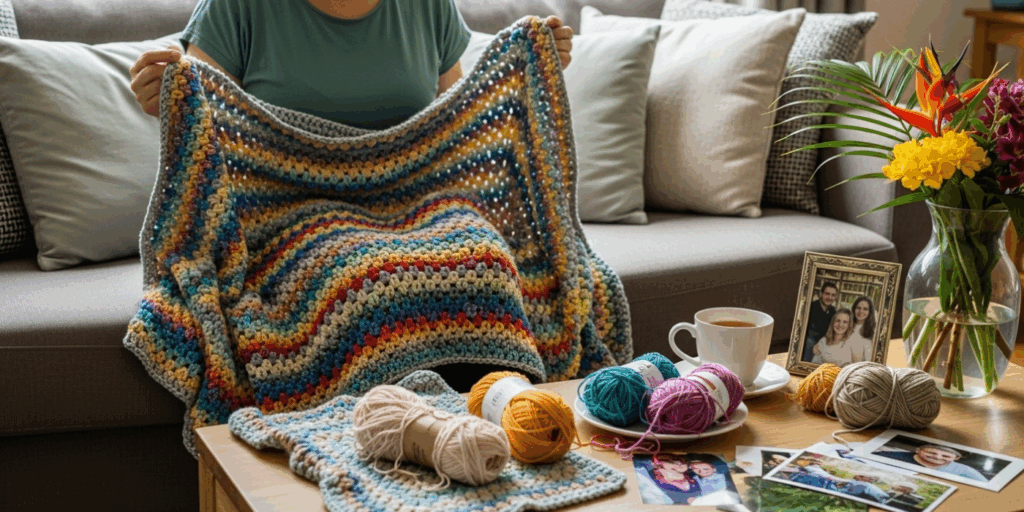
Here’s the most beautiful part of crochet: it turns solitude into connection.
Once you’ve made your first scarf, you’ll want to give it away. Maybe to your mom. Or a friend going through a hard time. Or even a stranger at a local shelter.
I once met a woman named Lena who started crocheting hats for newborns in her hospital’s NICU. “I didn’t know how to crochet,” she told me. “But I saw how cold those tiny babies looked. So I learned. Now I make 100 a year. I’ve never felt so useful.”
You don’t need to be a pro to give something meaningful. A simple beanie. A cozy blanket. A stuffed bunny with mismatched eyes. These aren’t just objects. They’re whispers of care.
Crochet communities are also incredibly warm. Online groups on Reddit, Facebook, and YouTube are filled with people cheering each other on. Post your first wobbly square. Someone will say, “I did that too—and I’m proud of you.”
And if you ever feel lonely? Pick up your hook. Someone, somewhere, is doing the exact same thing right now. You’re not alone. You’re part of a quiet, global sisterhood (and brotherhood!) of makers.
Start small. Make one thing. Give it away. Watch how it comes back to you—in smiles, in thanks, in connection.
Ready? Your First Project Starts Now
You’ve learned the tools. You’ve practiced the stitches. You’ve seen the science. You’ve heard the stories.
Now it’s time to make something.
Here’s your simple, no-fail beginner project: The Dishcloth
- Chain 25
- Single crochet in the second chain from hook, and across (24 stitches)
- Chain 1, turn
- Single crochet across
- Repeat until you have a square (about 7–8 inches)
- Fasten off. Weave in the ends.
Done. In under an hour. And it’s useful. You can use it. Give it. Or keep it as your first trophy.
This isn’t just a dishcloth. It’s proof that you can learn something new. That you can create. That you can slow down and still accomplish something beautiful.
Crochet isn’t about being perfect. It’s about being present.
So grab your hook. Find that ball of yarn tucked in the back of your closet. Or pick up a $3 skein at your local craft store. Start with one chain. Then another. Then another.
You don’t need permission. You don’t need talent. You just need to begin.
Your Turn: What Will You Make First?
I’d love to hear from you.
What’s the first thing you’re going to crochet? A cozy blanket for your couch? A gift for someone special? A silly little amigurumi creature that makes you smile?
Drop a comment below and tell me your plan—or even just your favorite color of yarn. Let’s build a little community of beginners, cheering each other on.
And if this guide helped you feel even a little more confident, please share it with someone who’s been curious about crochet but didn’t know where to start. Sometimes, the most powerful gift you can give is the spark of possibility.
The yarn is waiting.
The hook is ready.
And you?
You’re more capable than you think.
Now go make something beautiful—with your hands, your heart, and one simple stitch at a time. 💛
Maria Santos is a dedicated crochet and knitting enthusiast who finds joy in turning simple strands of yarn into meaningful, handmade art. With a natural eye for detail and a deep love for fiber crafts, she brings warmth, creativity, and years of personal experience to every project. Maria is inspired by the stories woven into each stitch and loves sharing that passion with others.