Introduction
You’ve carefully chosen your pattern, matched your hook size, and even swatched to check your gauge—yet your finished project still doesn’t look quite right. The texture feels off, the drape is stiffer than expected, or your stitches lack definition. If this sounds familiar, the issue might not be your tension or your technique… it could be your yarn’s ply.
Ply—the number of individual strands twisted together to form a single yarn—plays a surprisingly powerful role in how your crochet behaves, feels, and ages. Yet it’s one of the most overlooked aspects of yarn selection, especially in today’s weight-focused labeling system.
In this guide, we’ll demystify yarn ply and show you exactly how strand count influences your work. You’ll learn the real differences between single-ply and multi-ply yarns, how ply affects durability and stitch clarity, and how to choose the right type for everything from baby blankets to market totes. Whether you’re a beginner who’s never heard the term “ply” or an experienced maker looking to refine your material intuition, this knowledge will help you make smarter, more confident yarn choices—so your projects turn out exactly as you imagine them.
Let’s dive in and discover how a simple twist of thread can transform your crochet.
1. What Is Yarn Ply? More Than Just a Number
At its simplest, ply refers to how many individual strands—called “singles”—are twisted together to create one yarn strand. A 2-ply yarn has two threads spun together; a 4-ply has four, and so on. The twist holds the fibers in place, adding strength, elasticity, and structure.
But here’s where things get tricky: ply does not equal yarn weight. While this used to be a fairly reliable rule (especially in the UK, where “4-ply” once meant fingering weight), modern yarn manufacturing has blurred those lines. Today, you can find:
- A bulky-weight yarn made from just two thick plies.
- A lace-weight yarn composed of eight fine plies.
So why focus on ply at all? Because it directly impacts how your yarn handles during crocheting and how your finished fabric performs over time.
Think of it like building a rope: one thread snaps easily, but twist several together, and you get resilience. The same principle applies to yarn. The number of plies—and how tightly they’re spun—determines whether your yarn will pill, stretch, split, or hold its shape beautifully. Understanding this helps you work with your yarn, not against it.
2. Single-Ply Yarn: Dreamy Softness with Real Trade-Offs
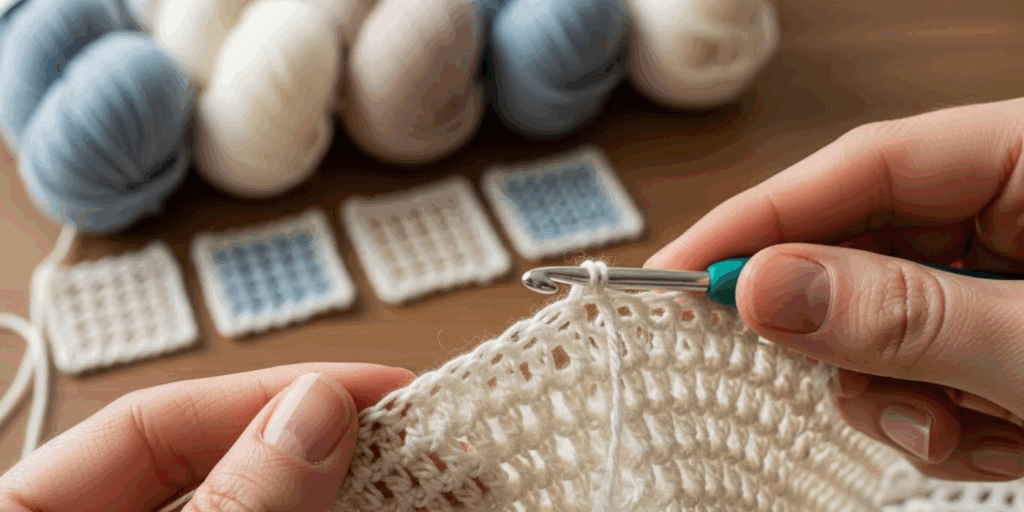
Single-ply yarn—made from just one continuous strand with no twist from other plies—has become a favorite for its unmatched softness and luxurious drape. Often found in high-end merino, alpaca, or cashmere blends, it’s the go-to for cozy cowls, delicate shawls, and sensory-friendly baby items.
The benefits are real:
- Incredibly soft and squishy to the touch
- Creates a fluid, elegant drape perfect for wearable garments
- Develops a beautiful “halo” (a soft fuzz that gives a dreamy glow)
But there’s a catch: single-ply yarn lacks the structural reinforcement that multiple plies provide. As a result, it’s more prone to:
- Pilling, especially in high-friction areas (like bag straps or sweater cuffs)
- Splitting on the hook if you’re not gentle
- Over-stretching or losing shape after washing
I learned this the hard way when I crocheted a gorgeous wrap in a single-ply merino—only to watch it pill after two wears. Now, I reserve single-ply for low-stress projects where softness matters more than durability.
Pro tip: If you do use single-ply, choose a smooth hook (like bamboo or ergonomic aluminum) and avoid tight tension. A slightly larger hook size than recommended can also reduce splitting and improve stitch flow.
3. Multi-Ply Yarns: Where Strength Meets Stitch Definition
Most commercial yarns today are multi-ply—typically 2, 3, 4, or more plies twisted together with balanced tension. This structure gives them a rounded, consistent shape that’s a joy to work with and performs reliably over time.
Let’s break down what different ply counts offer:
- 2-ply yarns often have a slightly flattened or oval cross-section. They’re common in sport and fingering weights and create a subtle, organic texture—great for rustic blankets or lightweight garments.
- 3-ply yarns are more cylindrical, leading to even, consistent stitches. Many worsted and DK yarns use this construction for reliability and softness.
- 4-ply and higher offer maximum stitch definition. They hold textured stitches like bobbles, cables, or popcorn stitches with crisp clarity—ideal for amigurumi, market bags, or home decor.
Real-life example: Compare a 4-ply cotton (like Lily Sugar’n Cream) with a single-ply cotton. The 4-ply will hold its shape in a dishcloth, while the single-ply might stretch and sag with repeated use.
Additionally, multi-ply yarns are less likely to pill because the twist traps loose fibers. That makes them perfect for high-use items like toys, kitchen linens, or children’s clothing.
So when durability, structure, or stitch clarity matters, multi-ply is your best friend.
4. How Ply Changes Your Fabric: Drape, Gauge, and Longevity
Here’s something many crocheters don’t realize: ply can subtly shift your gauge and fabric behavior—even when two yarns are labeled the same weight.
Why? Because multi-ply yarns are often denser and less compressible than single-ply. A 4-ply worsted yarn may produce slightly tighter, more defined stitches than a single-ply worsted of the same diameter, simply because its plies resist flattening under tension.
This affects three key areas:
✅ Drape:
- Single-ply = fluid, flowing, romantic
- Multi-ply = structured, firm, stable
✅ Washability:
- Tightly plied yarns hold up better in the machine.
- Single-ply may bloom (soften and spread) or felt unpredictably.
✅ Elasticity & Memory:
- Multi-ply yarns often “bounce back” after stretching—great for hats, socks, or fitted garments.
- Single-ply may stretch permanently, especially when wet.
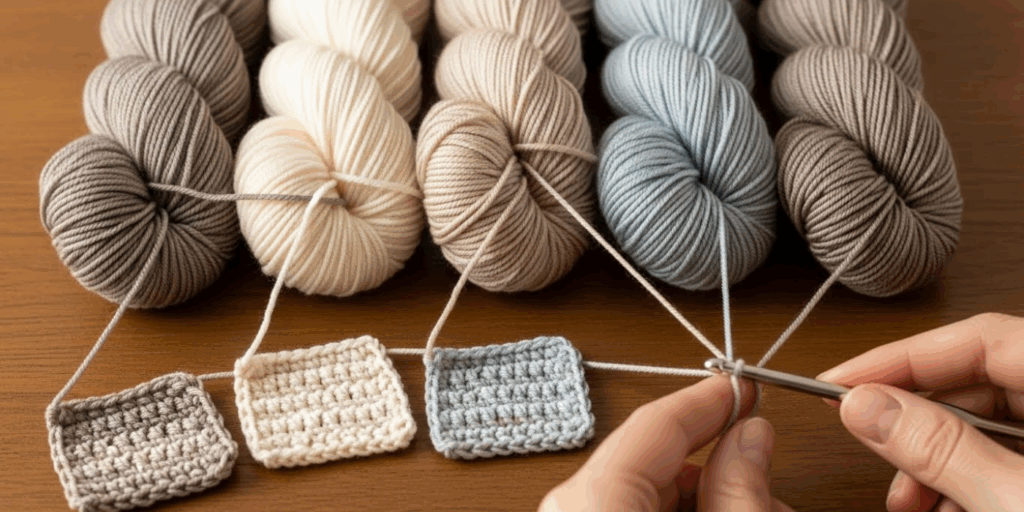
Try this: Swatch the same pattern in a single-ply and a 4-ply yarn of the same weight. Wash and block both. You’ll likely see clear differences in size, texture, and hand feel. That’s the hidden power of ply in action.
Practical takeaway: Always swatch—and wash your swatch—if your project’s fit or drape is critical. It’s the only way to truly know how your yarn will behave.
5. Choosing the Right Ply for Your Project: A Simple Framework
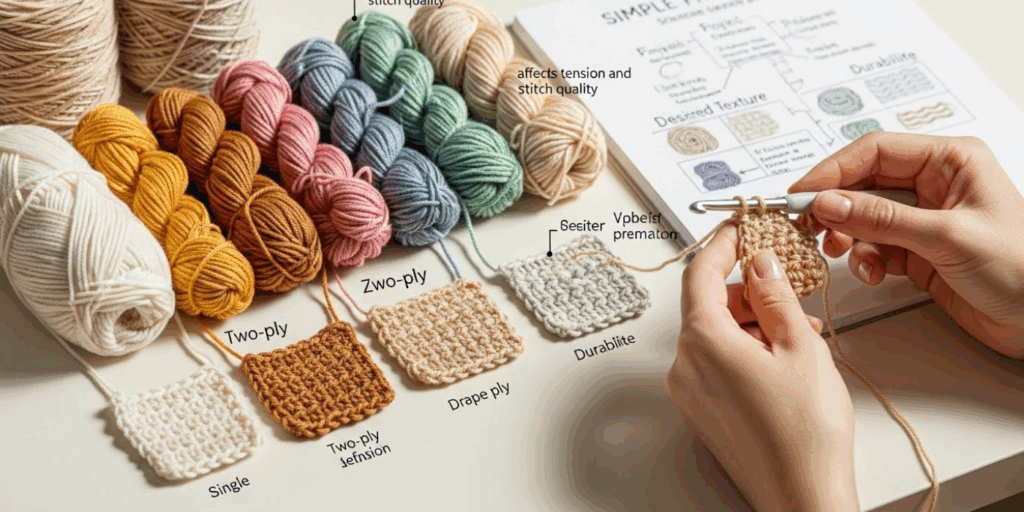
Feeling overwhelmed? Use this quick decision guide:
🔹 Ask: What is this item’s purpose?
- High-wear or functional (tote bags, dishcloths, kids’ clothes) → Choose 3+ ply for durability.
- Decorative or low-friction (shawls, wall hangings, photo props) → Single-ply is safe and stunning.
🔹 Ask: Do I need stitch definition?
- Textured stitches (bobbles, cables, lace clusters) → Go for 3- or 4-ply.
- Minimalist, blended look (like a cozy throw) → Single- or 2-ply adds softness.
🔹 Ask: What’s more important—softness or longevity?
- Prioritize softness? Single-ply delivers.
- Need it to last? Multi-ply wins.
Bonus tip: Can’t find ply info on the label? Examine the yarn closely. Gently roll it between your fingers. If you can see or feel distinct strands, it’s multi-ply. If it feels like one smooth rope, it’s likely single-ply.
Remember: More plies isn’t always “better.” A well-spun 2-ply can outperform a loosely twisted 6-ply. It’s about quality of twist, not just quantity.
6. Busting Common Myths About Yarn Ply
Let’s clear up some persistent misconceptions:
❌ Myth: “Ply tells you the yarn weight.”
✅ Truth: Ply and weight are related but not the same. Always rely on the Craft Yarn Council’s standard weight system (0–7) or the suggested hook size—not ply count.
❌ Myth: “Single-ply yarn is cheap or low quality.”
✅ Truth: Many artisan and luxury yarns are intentionally single-ply to highlight fiber softness and drape. It’s a design choice, not a flaw.
❌ Myth: “You can’t crochet with single-ply yarn.”
✅ Truth: You absolutely can! Just use a slightly larger hook, relax your tension, and avoid aggressive hooking motions.
Understanding these nuances helps you shop with confidence—no matter what the label says.
7. Navigating Global Ply Labels: Why “4-Ply” Means Different Things Worldwide
Here’s a major source of confusion: ply terminology varies by country.
- In the UK and Australia, “4-ply” traditionally refers to fingering weight, while “DK” is called “8-ply”—even though actual strand count may differ.
- In the U.S., commercial yarns rarely mention ply. Instead, they use the standard weight system (Lace = 0, Super Fine = 1, Fine = 2, Light = 3, Medium = 4, etc.).
- European yarns often list meters per 50g, which is more reliable than ply for comparing thickness.
What should you do?
When shopping internationally:
- Ignore the word “ply” as a weight indicator.
- Compare meterage per 100g (e.g., 400m/100g = fingering weight).
- Check suggested hook size—this is universal.
And always swatch. No label—no matter how detailed—can replace the wisdom of your own hands.
Conclusion
Understanding yarn ply isn’t about memorizing technical specs—it’s about learning to listen to your yarn. Ply influences how your fabric drapes, how clearly your stitches show, and how well your project holds up over time. By recognizing whether your yarn is single-ply or multi-ply, you gain creative control that goes far beyond color and fiber content.
To recap:
- Single-ply = soft, drapey, dreamy—but best for low-wear items.
- Multi-ply = durable, defined, reliable—for everyday use and intricate designs.
- Ply ≠ weight, so always check gauge with a washed swatch.
- Global labels vary, so focus on meterage and hook size when in doubt.
The next time you pick up a skein, take a moment to examine its structure. Give it a gentle tug. Notice how it feels on your hook. That small act of mindfulness can be the difference between a project that’s almost right—and one that’s exactly perfect.
Now we’d love to hear from you: What’s your favorite ply to crochet with—and what project taught you its true character? Share your story in the comments! Whether you swear by 4-ply cotton for dishcloths or live for the squish of single-ply merino, your experience helps us all stitch smarter.
Happy crocheting—and may your yarn always behave just the way you hope it will!
Maria Santos is a dedicated crochet and knitting enthusiast who finds joy in turning simple strands of yarn into meaningful, handmade art. With a natural eye for detail and a deep love for fiber crafts, she brings warmth, creativity, and years of personal experience to every project. Maria is inspired by the stories woven into each stitch and loves sharing that passion with others.