
You’ve spent countless evenings curling up with a hook and yarn, creating cozy blankets, adorable amigurumi, and delicate lace doilies. Maybe you’ve even gifted them to friends who say, “You should sell these!” But you laughed it off—thinking, “It’s just a hobby. I don’t want to turn my peace into a job.”
Here’s the truth: your crochet skills are more valuable than you realize.
In 2024, the global handmade crafts market was valued at over $40 billion—and growing. Etsy alone saw more than 90 million active buyers last year, with crochet items consistently ranking among the top-selling handmade categories. From personalized baby blankets to trendy granny-square bags, people are obsessed with handmade, unique, and heartfelt crochet pieces.
This isn’t about becoming a millionaire overnight. It’s about transforming something you love—something that brings you joy—into a sustainable side hustle (or even a full-time income). And the best part? You don’t need fancy equipment, a business degree, or a huge social media following to start.
In this guide, we’ll walk you through the real, step-by-step process of turning your crochet hobby into a profitable business. We’ll cover how to price your work fairly, where to sell it, how to build a brand that stands out, and—even more importantly—how to protect your joy while you grow.
By the end, you’ll have a clear roadmap—not just theory, but practical, doable steps you can start today. Whether you want to earn $200 a month on weekends or quit your 9-to-5 in two years, this is your sign to take the first stitch.
1. Stop Underpricing—Your Time Is Worth More Than You Think
Let’s get real for a moment.
How much do you charge for a crocheted hat? $5? $10? Maybe you gave one away as a gift and thought, “It’s just yarn and a few hours.”
But here’s what you’re not counting:
- The time spent choosing the perfect yarn.
- The mental energy of designing or following a pattern.
- The cost of shipping materials, packaging, and taxes.
- The emotional labor of creating something with care.
A 2023 survey by Craft Yarn Council found that 73% of crocheters undercharge because they don’t see their time as “real work.” But if you’re selling to make money, your labor is your biggest asset.
So how do you price fairly? Use this simple formula:
Cost of Materials + (Hourly Rate × Time Spent) + Overhead + Profit Margin = Final Price
Let’s say you make a granny square tote bag:
- Yarn and notions: $8
- Time spent: 6 hours
- Your fair hourly rate: $15 (yes, even if you’re just starting!)
- Overhead (packaging, listing fees, etc.): $3
- Profit margin (20%): $3.60
Total: $8 + $90 + $3 + $3.60 = $104.60
That’s not “too expensive.” That’s fair.
Think of it this way: if you bought a hand-knit sweater at a boutique, would you expect to pay $20? Probably not. You’d pay $80–$150. Why? Because you value the craftsmanship.
Your work is no different.
Start by researching similar items on Etsy or Instagram. See what experienced sellers charge. Then give yourself permission to match—or even exceed—those prices.
And if someone says, “That’s too much,” smile and say:
“This took me 6 hours of focused creativity, premium materials, and lots of love. I’m proud of it—and I hope you are too.”
Your value isn’t in the yarn. It’s in the heart you put into every stitch.
2. Find Your Niche—Because “Crochet Items” Isn’t Enough
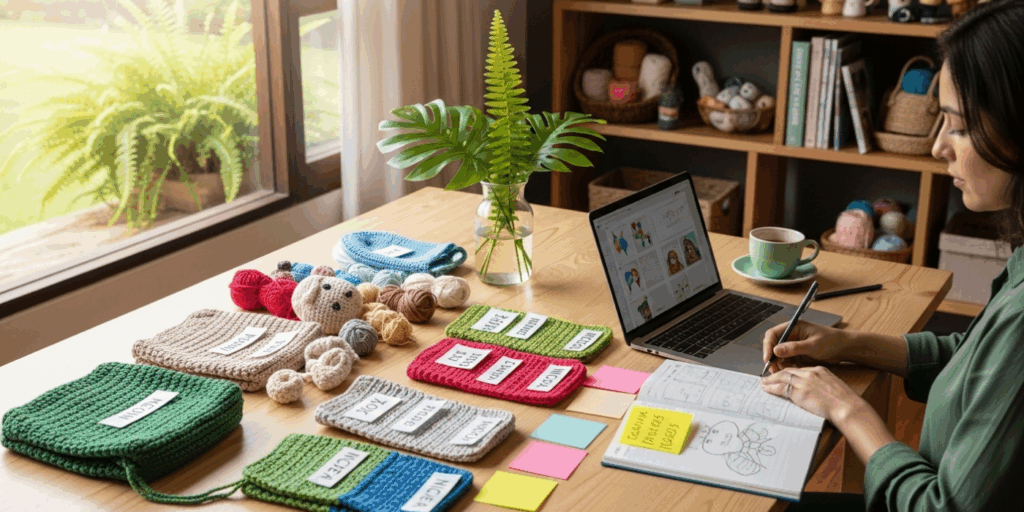
You might think, “I just crochet things. Blankets, hats, animals—I do it all.”
But here’s the secret: the most successful crochet businesses aren’t general—they’re specific.
Think about it:
- A shop selling “crochet hats” gets lost in a sea of competitors.
- A shop selling “hypoallergenic crochet beanies for sensitive scalps” stands out.
Your niche is your superpower.
Start by asking yourself:
- Who do I love making things for? (New moms? Pet lovers? Eco-conscious millennials?)
- What do people keep asking me to make?
- What kind of crochet makes me lose track of time?
Here are 5 proven niche ideas that are selling right now:
- Custom pet portraits in amigurumi — People will pay $60+ for a crochet version of their dog.
- Gender-neutral baby blankets with modern patterns — No more pink-and-blue clichés.
- Eco-friendly crochet kitchenware (dishcloths, scrubbers) — Big on TikTok and Instagram.
- Crochet jewelry (earrings, necklaces) — Lightweight, affordable, and perfect for impulse buys.
- Themed seasonal collections — Think “Autumn Forest Amigurumi” or “Holiday Ornaments with LED lights.”
One crocheter, Sarah from Ohio, started making “Crochet Cactus Planters” after her friends kept asking for them. Within 6 months, she was selling 50+ per month at $35 each. Her secret? She didn’t just sell planters—she sold vibes. Her brand: “Succulent & Stitched.”
Your niche doesn’t have to be huge. It just has to be yours.
Start small. Test one idea. Post three items. See what resonates. Then double down.
The goal isn’t to appeal to everyone. It’s to deeply connect with the right few.
3. Sell Where Your Customers Already Are (No Website Needed!)
You don’t need a fancy website to start making money. In fact, most successful crocheters begin on platforms where buyers are already searching.
Here’s where to focus:
Etsy — The #1 marketplace for handmade goods.
- Pros: Built-in traffic, easy setup, trusted by buyers.
- Cons: Fees (listing + transaction + payment processing = ~15%).
- Tip: Use keywords like “handmade crochet,” “custom amigurumi,” “gift for crochet lover.”
Instagram & TikTok — Visual platforms perfect for crafts.
- Post short videos of your process: “Watch this blanket come to life in 60 seconds.”
- Use trending sounds and hashtags like #CrochetLife, #HandmadeWithLove, #CrochetBusiness.
- Link your Etsy shop in your bio.
Local Markets & Pop-Ups — Don’t underestimate the power of face-to-face sales.
- Farmers’ markets, craft fairs, and holiday bazaars are goldmines.
- Bring samples, a small sign with your brand name, and QR codes linking to your shop.
Facebook Groups — Join local “Handmade in [Your City]” or “Crochet Enthusiasts” groups.
- Offer limited-time discounts to group members.
- People love supporting local creators.
Pro Tip: Start with one platform. Master it. Then expand.
I know a woman named Linda who started selling on Etsy. After 3 months, she noticed most of her traffic came from Instagram. So she posted daily Reels—showing her hands crocheting while listening to jazz. Within a year, she had 12K followers and was selling out every new collection.
You don’t need to be perfect. You just need to be consistent.
Start with one post a week. One product. One story.
Your audience is waiting. They just haven’t found you yet.
4. Build a Brand That Feels Like a Hug (Not a Storefront)
Here’s the magic trick most new sellers miss:
People don’t buy crochet items. They buy feelings.
They buy the comfort of a handmade blanket after a long day.
They buy the joy of giving a pet-shaped amigurumi to a child.
They buy the peace of knowing something was made slowly, with care, by a real person.
So your brand isn’t just your logo or your shop name.
It’s your story.
Ask yourself:
- Why did I start crocheting?
- What does this craft mean to me?
- How do I want my customers to feel when they receive my work?
Then weave that into everything:
- Shop Name: “Stitch & Soul” sounds warmer than “CrochetByJane.”
- Packaging: Use recycled paper, tie with twine, add a handwritten thank-you note.
- Photos: Show your items in cozy settings—a mug beside a blanket, sunlight on a hat, a cat curled up with your amigurumi.
- About Page: Share your journey. “I started crocheting during chemotherapy. This became my therapy. Now I share it with you.”
One seller, Marcus, turned his “Crochet for Mental Health” brand into a movement. He donates 10% of profits to anxiety charities and includes a small card in every order: “You are not alone. This was made for you.”
Sales soared.
Customers didn’t just buy a scarf. They bought belonging.
Your brand doesn’t need to be flashy. It just needs to be human.
Start today: Write your “why” in one sentence. Put it on your Etsy shop. Say it out loud.
That’s your brand. That’s your power.
5. Scale Without Burning Out—The Secret to Long-Term Joy

Here’s the biggest mistake crocheters make:
They fall in love with making… then get overwhelmed by orders.
They start saying “yes” to everything.
They work late nights.
They skip meals.
They lose the joy.
And then—burnout.
You don’t have to grow fast to grow strong.
Here’s how to scale sustainably:
✅ Set Limits
- “I take 5 custom orders per month.”
- “I only work 10 hours a week on my business.”
- “I close for holidays—no exceptions.”
✅ Offer Kits & Patterns
Instead of making 10 identical blankets, create a pattern and sell it for $8.
You earn $800 with zero shipping, zero materials, zero stress.
✅ Batch Your Work
Make 3 hats in one day. Then 3 blankets the next.
It’s faster, more efficient, and less mentally draining.
✅ Outsource When You Can
Need help with packaging? Hire a college student for $10/hour.
Want to expand into embroidery? Partner with a local seamstress.
✅ Celebrate Small Wins
You made $50 this week? That’s 5 hours of joy turned into income.
You got your first 5-star review? That’s validation.
Remember: Your business should serve your life—not the other way around.
I once spoke with a crocheter who hit $10K/month. She laughed and said, “I only work 20 hours a week. The rest? I nap. I hike. I crochet for fun.”
That’s the dream.
You don’t need to be a machine. You just need to be intentional.
6. Your First Step Starts Right Now (Yes, Today)
You’ve read this far. That means you’re ready.
So here’s your challenge:
Today, do ONE thing to start your crochet business.
- List one item on Etsy.
- Take a photo of your favorite piece and post it on Instagram with the caption: “Made with love. Want one?”
- Write your “why” on a sticky note and put it on your yarn shelf.
- Calculate your first fair price using the formula above.
Don’t wait for “perfect.” Don’t wait for more yarn. Don’t wait until you “feel ready.”
The perfect time was yesterday. The next best time is now.
Crocheting isn’t just about loops and stitches. It’s about creating beauty in a world that often feels rushed and mass-produced.
When you turn your craft into a business, you’re not just selling blankets—you’re offering a quiet rebellion against fast fashion. You’re saying:
“I believe in slow, thoughtful, heartfelt making.”
And that’s worth more than any price tag.
Conclusion: Your Hook, Your Heart, Your Legacy
Let’s recap what we’ve covered:
You learned how to price your work fairly—so you’re no longer undervaluing your time.
You discovered the power of niching down to stand out in a crowded market.
You found out where to sell without a website (and how to do it well).
You realized your brand isn’t a logo—it’s the emotion you create.
And you now know how to grow without losing the joy that started it all.
This isn’t about becoming the next “Crochet Queen” on TikTok.
It’s about building something real. Something yours. Something that brings you income and peace.
You’ve already done the hardest part: you’ve learned to crochet.
Now, you’re learning to value yourself.
So go ahead. Take that first photo. List that first item. Send that first message to a friend: “Hey, I’m starting to sell my crochet—want to be my first customer?”
You don’t need permission.
You don’t need a degree.
You just need to begin.
And when you do?
The world will notice.
Because handmade things? They don’t just fill spaces.
They heal hearts.
Your Turn:
What’s the first crochet item you’re going to turn into a product? Drop it in the comments below—I’d love to cheer you on! And if this guide helped you, share it with a fellow crocheter who needs to hear this.
Your next masterpiece is waiting.
Now go make it. 🧶💛
Maria Santos is a dedicated crochet and knitting enthusiast who finds joy in turning simple strands of yarn into meaningful, handmade art. With a natural eye for detail and a deep love for fiber crafts, she brings warmth, creativity, and years of personal experience to every project. Maria is inspired by the stories woven into each stitch and loves sharing that passion with others.