You’ve got your hook. You’ve got your yarn. You’ve even picked out the perfect pattern. But when you sit down to start that cozy blanket—or that adorable amigurumi unicorn—you realize… something’s missing. Not the yarn color. Not the hook size. Something small. Something you didn’t even know you needed until you were halfway through your project, frantically searching your craft drawer for a stitch marker that vanished into the void of your couch cushions.
Welcome to the secret world of crochet notions.
Most beginners think crochet is just hooks and yarn. And sure, those are the stars of the show. But like any great performance, the real magic happens because of the unsung heroes backstage—the little tools, gadgets, and helpers that turn frustration into flow, and messy projects into masterpieces.
In this article, we’re diving deep into the essential crochet notions you didn’t know you needed—but once you try them, you’ll wonder how you ever crocheted without them. From stitch markers that whisper encouragement to tape measures that don’t lie, these aren’t just “nice-to-haves.” They’re game-changers.
Whether you’re a newbie just starting out or a seasoned crafter who’s still losing track of where your last row ended, these tools will save you time, reduce stress, and make your crochet experience infinitely more joyful. Let’s meet the quiet champions of your craft.
1. Stitch Markers: Your Project’s Personal GPS
Let’s be honest—how many times have you looked at your work and thought, “Wait… was that the increase row or the decrease row?” Or worse—“Did I even do a stitch here?”
That’s where stitch markers come in.
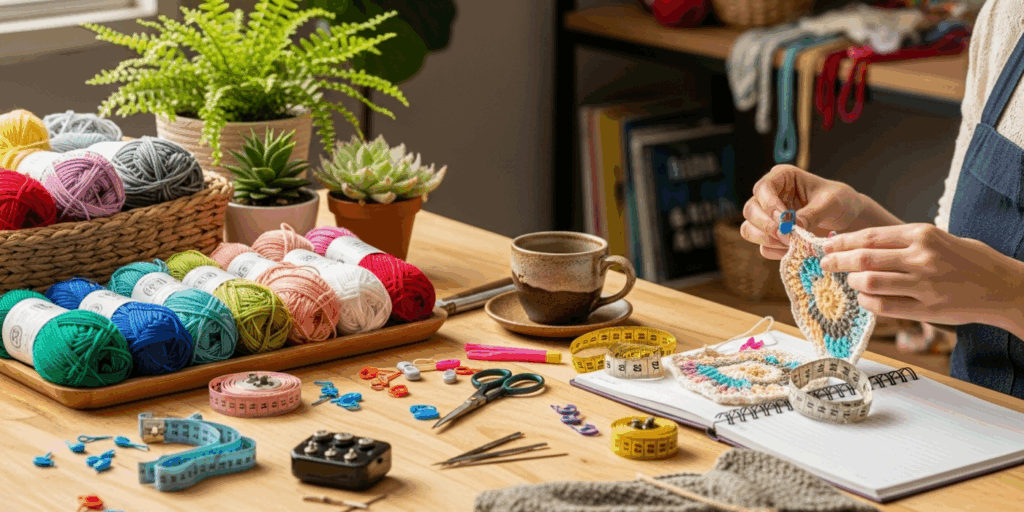
These tiny rings, clips, or loops are like little signposts for your crochet journey. They mark the beginning of a round, highlight pattern repeats, or even just remind you where your last stitch ended. And no, you don’t need fancy ones. Even a safety pin or a scrap of contrasting yarn tied in a loop works in a pinch.
But if you’re serious about clean, error-free projects, invest in a set of plastic or metal ring markers. They slide easily onto your hook, don’t snag your yarn, and stay put—even when you’re watching Netflix and crocheting at 10 p.m. (no judgment here).
I once spent three hours unraveling a baby blanket because I lost track of where my increases started. Three hours. All because I didn’t use a stitch marker. Lesson learned.
Pro Tip: Use different colored markers for different sections. A red one for the start of each round, a blue one for the center of a motif, a green one for your “don’t forget to chain 3 here” spot. Your future self will thank you.
And if you’re working in the round (like hats, amigurumi, or coasters), stitch markers are non-negotiable. Without them, your circle will twist, your increases will drift, and your project will look… well, like a sad, lopsided pancake.
2. Tape Measures and Row Counters: The Truth-Tellers You Didn’t Know You Craved

Crochet is a forgiving art. But it’s also sneaky.
You think you’ve made 15 rows. You’re sure of it. But when you lay your work flat and pull out the tape measure… 18 rows. And your hat is now way too small. Or your sweater sleeve is longer than your arm.
Enter the humble tape measure.
A flexible, retractable tape measure (the kind tailors use) is one of the most underrated tools in your kit. It’s not just for measuring finished pieces—it’s your best friend for checking gauge, tracking progress, and avoiding “I thought it was supposed to be this big” disasters.
And here’s the kicker: gauge matters. Even if you’re making a scarf, if your stitches are tighter or looser than the pattern calls for, your finished item might be unusable. A tape measure helps you catch that early.
Now pair that with a row counter.
Yes, there are apps. Yes, you can jot it down in a notebook. But nothing beats a physical row counter. These tiny clickers (some clip onto your hook, others sit in your pocket) let you tap your way through rows without breaking your flow. I’ve seen crocheters use tally marks on sticky notes. It works. But it’s messy. And when your coffee spills? Goodbye, row 47.
I use a simple metal clicker that fits on my keychain. Every time I finish a row, I click. It’s satisfying. It’s reliable. And it’s saved me from more than one “Why is this scarf 7 feet long?!” moments.
Bonus: Some row counters double as stitch counters. If you’re working on a complex lace pattern with multiple increases and decreases, having both functions in one tool is pure magic.
3. Scissors, Yarn Needles, and Snips: The Quiet Heroes of Finishing
You’ve finished your last stitch. You’ve cut the yarn. Now what?
If you’re just yanking the tail and calling it done… you’re setting yourself up for unraveling. Fast.
That’s where yarn needles (also called tapestry needles) come in. These big-eyed, blunt-tipped needles are designed to weave in your ends neatly and securely. No sharp point to poke your fingers (or your project). Just smooth, quiet magic.
I used to hate weaving in ends. It felt tedious. But then I realized: a well-hidden end is what separates a handmade project from a sloppy one. Your blanket won’t come apart at the seams. Your amigurumi won’t lose a leg. Your scarf won’t unravel on the first cold day.
And don’t underestimate the power of small, sharp scissors.
Not the big kitchen scissors. Not the one you use to cut paper. A pair of tiny, precision scissors—like embroidery scissors or nail scissors—makes cutting yarn clean, quick, and painless. You’ll thank yourself when you’re trimming 50 ends on a granny square blanket and your fingers aren’t cramping.
Pro Tip: Keep a small pouch with your scissors, yarn needle, and a few extra stitch markers in your crochet bag. That way, you’re always ready to finish a project—even if you’re on the couch, in the car, or at a friend’s house.
I once finished a gift blanket at 11 p.m. on Christmas Eve. I had no time to go back to my craft room. But I had my little pouch. And that’s how I got my mom a perfectly finished gift… with time to spare.
4. Blocking Mats and Pins: Turning “Okay” Into “Wow”
You’ve crocheted a beautiful shawl. It’s lacey, it’s intricate, it’s yours. But when you lay it flat, it looks… wrinkled. Crooked. Like it’s had a rough day.
That’s where blocking comes in.
Blocking isn’t just for knitters. Crocheters need it too—especially when working with lace, delicate fibers, or projects that need to lie flat (like doilies, afghans, or garments).
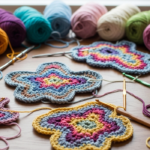
Blocking mats (usually foam puzzle pieces) and rust-proof T-pins are your secret weapons. You lay your piece on the mat, gently stretch it into shape, pin it down, mist it with water, and let it dry. Overnight. And when you remove the pins? It’s transformed.
I blocked my first lace shawl and cried. Not from sadness—from awe. It went from “meh” to “I made this?!” in one night.
You don’t need a fancy setup. A towel on the floor and some safety pins work in a pinch. But if you’re serious about elevating your craft, blocking is the difference between “I made this” and “I crafted this.”
Bonus Insight: Blocking also helps even out uneven stitches. If your tension varies (and let’s be real—whose doesn’t?), blocking smooths it out like a magic iron for crochet.
And yes—it’s worth the extra time. Your finished pieces will look professional, polished, and worth displaying. Not just hiding in a drawer.
5. Project Bags, Notion Organizers, and the Power of Order

Let’s talk about the emotional side of crochet.
You know that feeling? You sit down to work. You open your bag. And you see it: a tangled mess of hooks, half-used yarn balls, loose stitch markers, broken needles, and a notebook with scribbles that only you (and maybe your cat) can read.
It’s not just clutter. It’s stress.
That’s why project bags and notion organizers aren’t just cute accessories—they’re mental health tools.
A well-organized bag means you can find your hook in 3 seconds. Your stitch markers are in their own little pouch. Your pattern is printed and clipped to a clipboard. No more frantic digging. No more “I just had it!” moments.
I used to carry everything in a grocery bag. Then I got a canvas project bag with compartments. My crochet time went from “I’m too tired to dig through this mess” to “Let’s just do five rows before bed.”
And if you’re feeling fancy, try a small plastic organizer with drawers—like those used for beads or sewing notions. Pop your stitch markers, row counters, scissors, and tape measure in separate slots. Label them if you need to. It’s therapeutic.
Here’s the truth: When your tools are organized, your mind is clearer. You focus more on the making and less on the searching.
Plus—let’s be real—there’s something deeply satisfying about opening a neat, tidy crochet bag. It feels like a gift to yourself.
6. Pattern Holders, Lighting, and the Little Things That Make All the Difference
Ever tried reading a pattern while holding your phone with one hand and crocheting with the other? Or squinting at tiny print under a dim lamp?
I’ve done it. And I’ve cried. (Okay, maybe just groaned loudly.)
A pattern holder—whether it’s a clip-on book holder, a tablet stand, or even a simple clipboard taped to your chair—keeps your instructions at eye level. No neck strain. No lost stitches. Just flow.
And lighting? Oh, lighting.
Crocheting under a yellow bulb at night? Bad idea. Your stitches look different under warm light than under daylight. You might miscount, misread your pattern, or strain your eyes.
A good LED lamp with adjustable brightness and color temperature (like a daylight bulb) makes a world of difference. I use a small gooseneck lamp that I clip to my armchair. It’s like having a spotlight on my work.
And if you’re working with fine yarn or lace? A magnifying lamp is a total game-changer. Seriously. I bought one for my grandma, who’s 82 and still crocheting beautiful doilies. She said, “I didn’t realize I was squinting until I saw how clear everything looked.”
Small things. Big impact.
Conclusion: It’s Not Just About the Hook—It’s About the Joy
So let’s bring it all together.
You don’t need a million tools to be a great crocheter. But you do need the right ones—the quiet, unglamorous, utterly essential notions that turn chaos into calm, frustration into flow, and good projects into great ones.
Stitch markers keep you on track.
Tape measures keep you honest.
Yarn needles give your work polish.
Blocking transforms your creations.
Organization keeps your peace.
Lighting and holders keep your body happy.
These aren’t luxuries. They’re the invisible threads that hold your craft together.
Think of it this way: You wouldn’t paint with your fingers and no brushes. You wouldn’t bake with no measuring cups. Crochet is the same. The hook and yarn are your foundation. But these little tools? They’re your wings.
They let you fly further, make more, and enjoy every stitch.
So next time you’re about to start a new project, pause for a moment. Look at your supplies. Are you missing something small that could make a big difference?
Maybe it’s a row counter. Maybe it’s a better pair of scissors. Maybe it’s just a little organizer to keep your markers from vanishing into the couch.
Try one new notion this week. Just one. See how it changes your experience.
And when you do? Come back here and tell me which one changed everything for you.
Because crochet isn’t just about making things.
It’s about making the process joyful.
And you? You deserve that.
Happy crocheting. 🧶
Maria Santos is a dedicated crochet and knitting enthusiast who finds joy in turning simple strands of yarn into meaningful, handmade art. With a natural eye for detail and a deep love for fiber crafts, she brings warmth, creativity, and years of personal experience to every project. Maria is inspired by the stories woven into each stitch and loves sharing that passion with others.