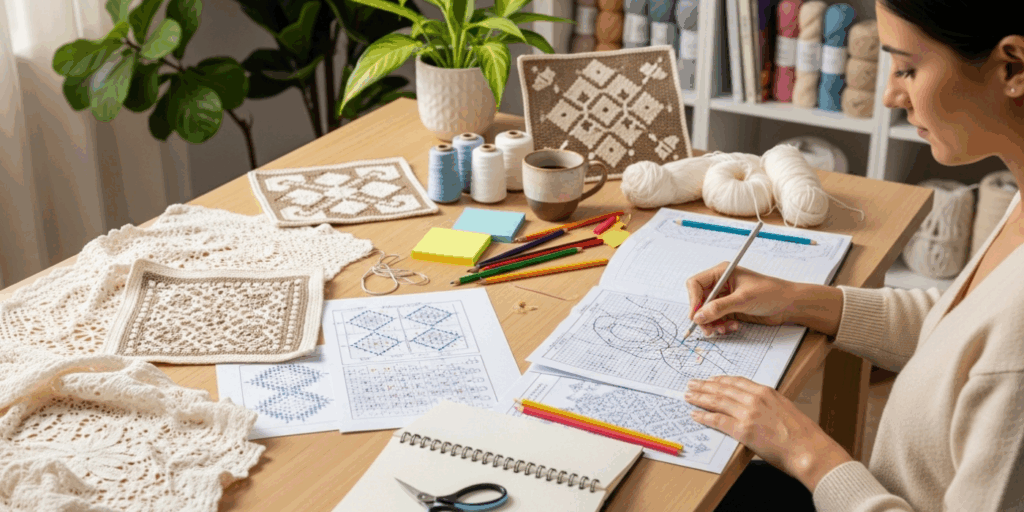
Imagine this: You’re sipping coffee on a quiet Sunday morning, sunlight streaming through the window, and in your lap lies a delicate, lace-like square of crochet—each open space and solid block forming a tiny, intricate image. Maybe it’s a blooming rose. Maybe it’s a hummingbird mid-flight. Or perhaps, just maybe, it’s your initials, woven into a blanket for your newborn. This isn’t magic. It’s filet crochet—and once you learn how to read and create your own charts, you’ll never look at crochet the same way again.
Filet crochet is more than just a technique; it’s a language. A silent, stitch-by-stitch dialogue between you and your design. Unlike traditional crochet patterns that rely on repetitive rows of double crochets, filet uses a grid system—solid blocks and open spaces—to create pictures, words, and patterns. It’s like pixel art, but with yarn and a hook. And here’s the best part: you don’t need to be a professional to make it. With the right guide, anyone can turn a simple sketch into a stunning piece of wearable or home art.
In this comprehensive guide, we’ll break down everything you need to know to read, interpret, and—most excitingly—create your own filet crochet charts from scratch. Whether you’re a beginner who’s never seen a filet chart before, or an experienced crocheter ready to level up, you’ll walk away with practical skills, insider tips, and the confidence to turn your favorite images into handmade masterpieces. Let’s dive in.
Why Filet Crochet? More Than Just Lace
You’ve probably seen filet crochet in doilies, table runners, or even vintage wedding veils. But why has it endured for centuries? Because it’s functional art. Unlike other lace techniques that prioritize drape and flow, filet crochet lets you tell stories with stitches.
Think about it: a grandmother might crochet her grandchildren’s names into a crib blanket. A modern crafter might recreate their favorite movie quote into a wall hanging. Filet crochet turns sentiment into structure. And the best part? It’s surprisingly forgiving. One missed stitch? No problem. The pattern’s built on a grid—you can easily count your way back on track.
What makes filet unique is its simplicity. You only need two basic stitches: the chain space (open mesh) and the double crochet (solid block). That’s it. Everything else—whether it’s a butterfly, a heart, or the Eiffel Tower—is built by alternating these two elements on a grid.
And here’s a fun fact: filet crochet was originally used in 17th-century Europe to create decorative panels for homes. Today, it’s making a massive comeback—not just in vintage circles, but in Etsy shops, Instagram feeds, and even high-end fashion. Designers are using it for minimalist wall art, tote bags, and even swimwear. Why? Because it’s timeless, customizable, and deeply personal.
If you’ve ever wished you could crochet something meaningful—not just another scarf or blanket—filet crochet is your gateway. It transforms your creativity from abstract to tangible. And the best part? You don’t need expensive tools. Just your hook, yarn, and a willingness to count.
Decoding the Filet Chart: Your Secret Decoder Ring
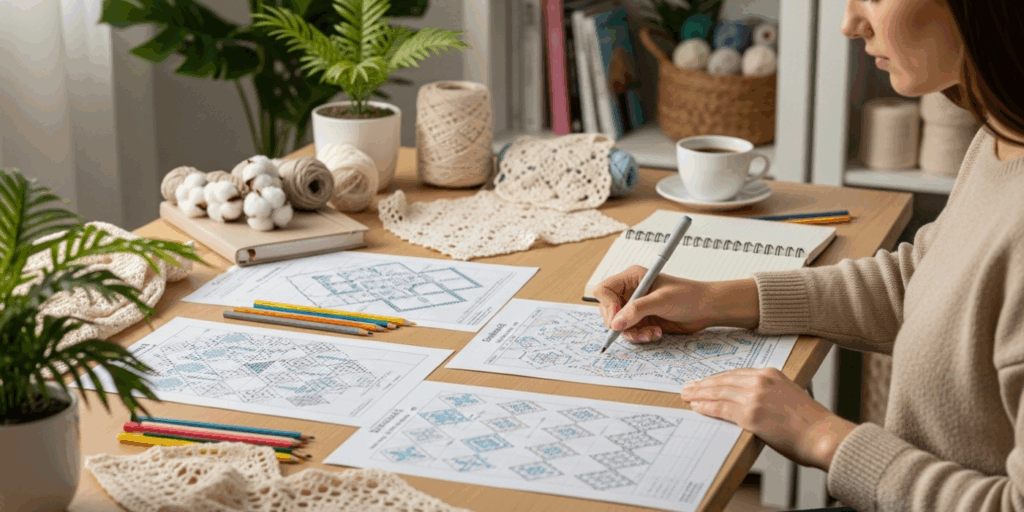
Let’s get practical. If you’ve ever stared at a filet crochet chart and felt like you were looking at a crossword puzzle written in alien hieroglyphs—you’re not alone.
A filet chart is a grid. Each square represents one stitch unit: either a solid square (three double crochets worked together) or a mesh square (two chains, one double crochet). The chart is read from bottom to top, right to left (for right-handed crocheters), just like reading a book.
Here’s how to decode it:
- Black or filled squares = Solid blocks (3 dc)
- White or empty squares = Open mesh (ch-2, dc)
- Numbers along the edges = Row and column counters (critical for accuracy!)
Let’s say you’re working on a simple heart pattern. The first row might look like this:
Empty, Empty, Solid, Solid, Solid, Empty, Empty
That’s your heart’s top curve. The next row?
Empty, Solid, Solid, Solid, Solid, Solid, Empty
Now you’re building the middle. Keep going, and soon—you’ll see the shape emerge.
Pro Tip: Use graph paper or a free digital tool like Stitch Fiddle or CrochetGrid to sketch your design first. Color in the squares you want solid. Then, transfer that to your chart. It’s like coloring a coloring book—but the colors become stitches.
Many beginners make the mistake of trying to crochet from memory or a photo. Don’t. Always use a chart. Why? Because your brain will fill in gaps… and you’ll end up with a lopsided dove instead of a swan. Charts are your safety net.
And here’s a game-changer: count every single square as you go. Use a highlighter or sticky note to mark your current row. It’s tedious, yes—but it’s the difference between a masterpiece and a mess.
Turning Images into Charts: From Photo to Pattern
Now, let’s get creative. You’ve got a photo of your dog. A quote from your favorite book. A silhouette of your favorite mountain. How do you turn that into a filet chart?
Start simple. Choose an image with clear contrast—high light/dark contrast works best. A black-and-white photo? Perfect. A blurry sunset? Not so much.
Here’s a step-by-step method:
- Resize your image to a small grid—say, 20×20 squares. Use free tools like Photopea or Canva to reduce the resolution.
- Convert to black and white. Increase the contrast so the shapes pop.
- Overlay a grid. Use a transparent grid layer (many apps have this feature).
- Color in the blocks. Every pixel that’s dark becomes a solid block. Every light pixel becomes a mesh.
- Clean it up. Remove stray pixels. Smooth jagged edges. Your goal is clarity, not perfection.
Let’s say you want to crochet “LOVE” in filet. You’d sketch each letter on a 5×7 grid per letter. “L” might be a vertical line of solids on the left, then a base of solids across the bottom. “O” would be a hollow square. “V” would be two diagonal lines meeting at the bottom. “E” would have three horizontal bars.
Once your chart is clean, test it with a small swatch. Crochet just one letter. If it looks right, you’re golden. If not, tweak the grid. Maybe the “O” needs an extra row. Maybe the “V” is too narrow. Adjust. Try again.
This is where filet crochet becomes your art. No two people will chart the same image the same way. That’s the beauty. It’s not about replicating reality—it’s about capturing the essence.
And here’s a pro secret: Start small. Don’t try to crochet a full portrait on your first try. Begin with a single flower, a star, or your initials. Master the grid before you tackle the Mona Lisa.
Designing Your Own Patterns: From Idea to Stitch
You’re ready to go beyond copying. You want to create something entirely original. Maybe a custom baby blanket with the child’s birth date. A birthday gift with a hidden message. A coaster with your favorite quote.
Here’s how to design your own filet pattern from scratch:
Step 1: Choose Your Message or Image
Is it a word? A shape? A symbol? Write it down. Keep it simple. “Peace” is easier than “The Road Not Taken.”
Step 2: Sketch It Out
Grab graph paper. Each square = one stitch unit. Use pencil so you can erase. Don’t worry about art skills. Stick figures work fine.
Step 3: Translate to Grid
Decide how tall and wide your design will be. For text, aim for 5–7 squares per letter. For symbols, give them breathing room. A heart might need 10 rows. A star, 8.
Step 4: Fill the Grid
Use a black pen or marker to fill in the solid blocks. Leave the rest blank. Now, imagine you’re crocheting it row by row. Does it look right? If a curve feels jagged, add a row. If something looks too crowded, widen it.
Step 5: Test and Refine
Crochet a 10-row sample. Take a photo. Step back. Does it look like what you envisioned? If not, go back to the grid. Crochet is forgiving. Your chart doesn’t have to be perfect on the first try.
Bonus Tip: Add a border. A simple single crochet border around your finished piece gives it polish and prevents curling. It also makes it easier to frame or sew into a larger project.
I once made a filet coaster for my best friend’s wedding with the date “06.15.2024” hidden in the corners. She cried when she saw it. Why? Because it wasn’t just a coaster. It was a memory, stitched into lace.
That’s the power of designing your own chart. You’re not just making something. You’re weaving intention into every stitch.
Common Mistakes (And How to Avoid Them)
Even experienced crocheters stumble with filet. Here are the top 5 mistakes—and how to dodge them:
- Not counting rows → You’ll lose your place. Solution: Use a row counter app or a physical counter. Mark each completed row with a clip or sticky note.
- Ignoring the starting chain → Filet starts with a chain that’s a multiple of 2 + 3. For example, for a 10-square-wide chart, you need (10 x 2) + 3 = 23 chains. Mess this up, and your pattern won’t align. Always double-check your foundation chain.
- Trying to rush → Filet is slow. It’s meditative. If you’re frustrated, take a break. Your hands remember what your mind forgets.
- Using the wrong yarn → Thin cotton or linen works best. Thick yarn hides the grid. You want definition. Recommended: Size 10 crochet thread or sport-weight cotton.
- Not blocking your finished piece → Filet tends to curl. After finishing, gently wet-block it: pin it to a towel, mist with water, let dry flat. It transforms from “meh” to magnificent.
And here’s one I wish I’d known sooner: Always leave extra yarn. You’ll need it for weaving in ends, adding borders, or fixing mistakes. I once ran out of yarn on a 3-foot blanket and had to frog 8 rows. Don’t be me.
The Joy of Creating Something Only You Could Make
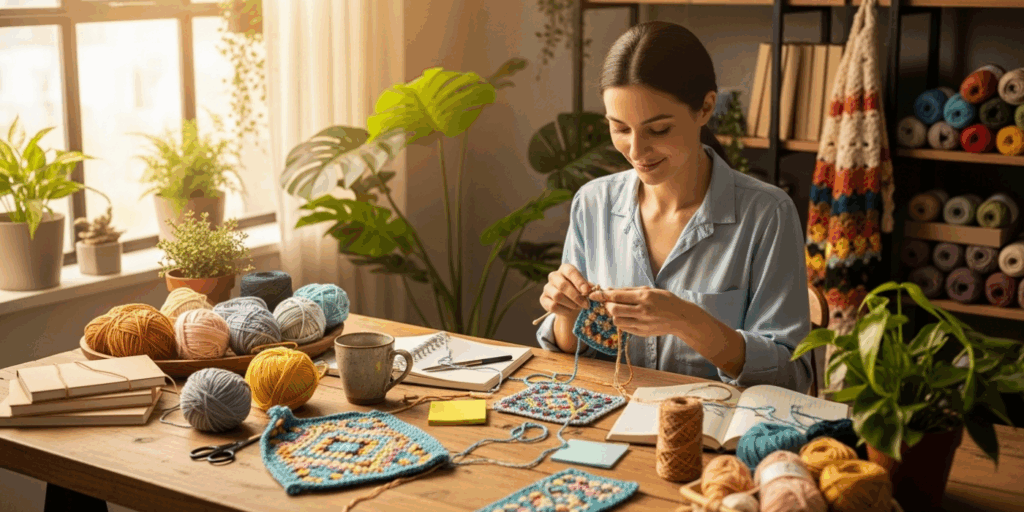
Filet crochet isn’t just about technique. It’s about presence.
In a world of mass-produced goods, filet invites you to slow down. To count. To pause. To make something that only you could have made—with your hands, your choices, your patience.
When you create your own chart, you’re not following instructions. You’re writing a story. Each solid block is a thought. Each open space, a breath. Together, they form something beautiful—something that didn’t exist before you decided to make it.
I’ve seen filet charts turn into heirlooms: a grandmother’s initials on a christening blanket, a couple’s wedding date on a pillow, a child’s first drawing turned into a wall hanging. These aren’t just crafts. They’re love letters in yarn.
So, what will your filet chart say?
Maybe it’s your favorite quote. A pet’s silhouette. A constellation from the night sky where you proposed. A tiny maple leaf from the tree outside your childhood home.
The chart is blank. The yarn is waiting. The hook is in your hand.
You don’t need permission to create something beautiful. You just need to start.
Ready to Begin? Here’s Your First Challenge
Now that you know how to read, decode, and design your own filet charts, it’s time to put it into practice.
Your mission (should you choose to accept it):
Pick one small image or word—just 5–7 squares wide. Sketch it on graph paper. Turn it into a chart. Then, crochet a 6-row sample.
Don’t worry if it’s imperfect. The goal isn’t perfection. It’s progress.
When you finish, take a photo. Share it in the comments below. Tag a friend who loves crafts. Celebrate the fact that you just turned an idea into something real—with nothing but yarn, a hook, and your own two hands.
Because here’s the truth: You don’t need to be an artist to make art. You just need to care enough to try.
So go ahead. Pick your first square. Chain one. And begin.
What will your filet story say? I’d love to hear it.
Maria Santos is a dedicated crochet and knitting enthusiast who finds joy in turning simple strands of yarn into meaningful, handmade art. With a natural eye for detail and a deep love for fiber crafts, she brings warmth, creativity, and years of personal experience to every project. Maria is inspired by the stories woven into each stitch and loves sharing that passion with others.