Imagine holding a vibrant, hand-crocheted blanket in your lap—swirls of cobalt blue melting into sunflower yellow, deep emerald vines curling around ivory hearts. You didn’t buy it. You made it. And it’s yours.
That’s the magic of colorwork crochet. It’s not just about making something pretty—it’s about turning yarn into storytelling. Whether you’re crafting a cozy baby blanket, a statement tote bag, or a festive holiday pillow, adding multiple colors doesn’t have to feel intimidating. In fact, once you understand the two most accessible techniques—intarsia and tapestry crochet—you’ll wonder why you ever thought colorwork was for “advanced” crocheters only.
In this guide, we’ll break down both methods step by step, using everyday language, real-life examples, and zero jargon. No more tangled yarn balls or confusing patterns. You’ll learn why one technique works better for geometric designs, how to avoid those pesky holes between colors, and which method saves you the most time (spoiler: it’s not what you think). By the end, you’ll have the confidence to pick up your hook and create something truly colorful—no experience needed.
Let’s dive in.
Why Colorwork Crochet Is More Accessible Than You Think
Let’s be honest: when you see a photo of a rainbow-striped afghan or a detailed floral motif in crochet, your first thought might be, “That’s way too complicated for me.” But here’s the truth—it’s not.
Colorwork crochet isn’t about being a pro. It’s about understanding two simple principles: how to manage yarn and when to switch colors. Think of it like painting with yarn instead of a brush. You don’t need an art degree—you just need to know where to dip your brush next.
The rise of social media platforms like Instagram and Pinterest has made colorwork crochet explode in popularity. Why? Because people crave handmade, personalized items. A plain beige scarf? Nice. A scarf with tiny bears wearing tiny hats? That’s a conversation starter.
And here’s the best part: you don’t need fancy tools. Your regular crochet hook, some scrap yarn, and 20 minutes of patience are all you need to start. Most colorwork patterns use basic stitches—single crochet, double crochet—nothing exotic. The magic happens in the how, not the what.
Plus, colorwork is therapeutic. There’s something deeply calming about switching from red to green, then back to cream, rhythmically building a pattern stitch by stitch. It’s like meditation with a hook.
So if you’ve been holding back because you think you “can’t do color,” let me tell you—you already can. You just haven’t tried the right method yet.
And that’s where intarsia and tapestry crochet come in. They’re your two best friends on this journey.
Intarsia Crochet: The Art of Clean, Blocky Color Changes
Picture a classic baby blanket with a big, bold star in the center—each point a different color, no blending, no strings crossing over. That’s intarsia.
In intarsia crochet, each color is worked with its own separate ball of yarn. When you switch colors, you don’t carry the unused yarn across the back. Instead, you drop it and pick up the next one. This keeps the back of your work neat and prevents long, awkward strands from showing through.
It’s perfect for large blocks of color—think geometric shapes, letters, animals, or pixel-art designs. It’s the go-to method for motifs like hearts, stars, or even your favorite cartoon character.
Here’s how it works in practice:
- You start with your first color (say, red).
- When you reach the edge where red meets yellow, you drop the red yarn.
- You pick up the yellow yarn and continue crocheting.
- Later, when you come back to red, you pick it up again right where you left off.
Pro tip: Use bobbins or small ziplock bags to hold each color. This keeps your yarn from tangling like a toddler’s headphone cord.
One common mistake? Trying to carry yarn across too many stitches. In intarsia, if you carry yarn even two or three stitches, you’ll create loose loops on the back that can snag or look messy. So always drop and pick up.
Intarsia is ideal if you’re making something like a crocheted pillow with a single large image—say, a cat’s face with green eyes and a pink nose. Each color stays isolated.
The downside? You’ll have more ends to weave in. But that’s a small price for that crisp, clean look. And honestly? Weaving in ends is satisfying. It’s like tidying up your masterpiece.
Think of intarsia as stained glass: each color has its own pane, perfectly separated. Beautiful. Bold. Unmistakable.
Tapestry Crochet: The Secret to Seamless, Continuous Color
Now imagine a blanket where the colors flow like water—soft gradients, intricate spirals, tiny diamonds woven right into the fabric. That’s tapestry crochet.
Unlike intarsia, tapestry crochet uses one continuous strand of yarn per row, carrying the unused color(s) along the back as you work. You’re essentially “weaving” the colors into the stitches themselves.
This technique is perfect for detailed, repeating patterns—think Celtic knots, floral vines, or even alphabet borders. It’s what makes those stunning “memory blankets” with tiny names and dates woven right into the fabric possible.
Here’s the magic trick: when you switch colors, you don’t cut the yarn. Instead, you pull the new color through the stitch over the old one, trapping it inside. The unused yarn runs invisibly behind your work, creating a thick, warm, double-layered fabric.
Why this matters: Tapestry crochet is warmer than intarsia because of that double layer. That’s why it’s so popular for winter hats, mittens, and cozy blankets.
But there’s a catch: if you carry yarn too loosely, you’ll get big, saggy loops on the back. Too tight? Your fabric puckers. The key? Keep tension even.
Try this: after switching colors, gently tug the carried yarn just enough to lie flat against the back—not stretched, not loose. Think of it like walking a dog: a little leash, but not a chokehold.
Tapestry is also fantastic for small, frequent color changes. Want to make a striped beanie with 8 different colors? Tapestry lets you do it without switching 8 balls of yarn every row.
A real-life example: My friend Lisa made a baby blanket using tapestry crochet to weave in the initials of all her nieces and nephews. Each letter was tiny—only 4 stitches wide—but they showed up clearly, like embroidery done in yarn. No one believed she didn’t sew them on afterward.
The downside? Tapestry can be slower. And it’s heavier. But the result? A fabric that looks like it was knit, not crocheted. Elegant. Dense. Timeless.
Choosing Between Intarsia and Tapestry: Which One Fits Your Project?
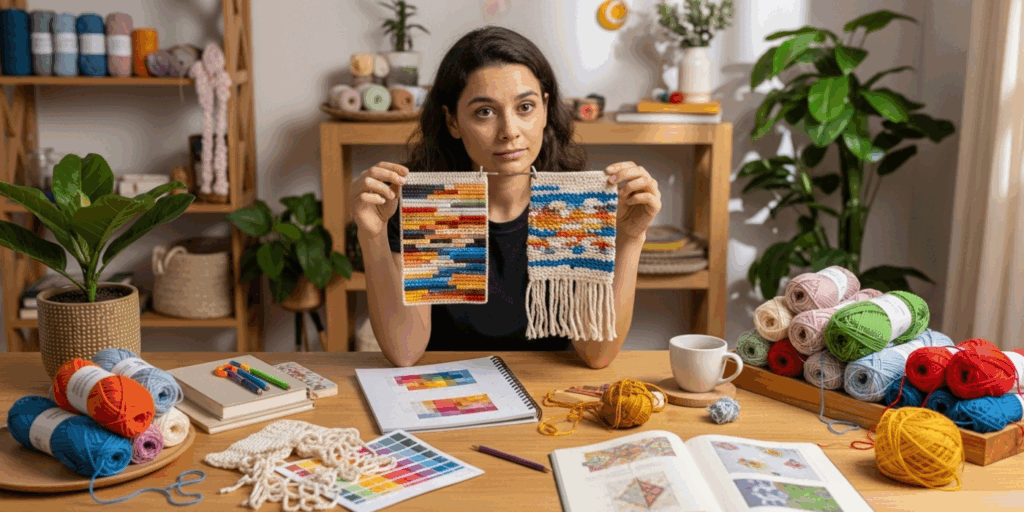
So… which should you use?
Let’s make this simple. Ask yourself three questions:
- Are your color changes big and few?
→ Go with intarsia. Think: one big flower, one letter, one animal. - Are your color changes small and frequent?
→ Go with tapestry. Think: stripes, checkerboards, tiny dots. - Do you want your project to be warm and thick?
→ Tapestry wins.
→ Need something lightweight and drapey? Intarsia is better.
Here’s a quick cheat sheet:
| Best for | Large color blocks | Small, frequent changes |
| Yarn management | Multiple balls | One ball per row |
| Back of work | Neat, but has ends | Slightly bulkier, no ends |
| Speed | Faster color switches | Slower, but continuous |
| Warmth | Lighter | Warmer (double layer) |
| Ideal project | Pillow, tote bag, baby onesie | Hat, scarf, blanket |
Real-life test: Last winter, I made two identical scarves—one with intarsia, one with tapestry. The intarsia version was quicker to make, but I had to weave in 22 ends. The tapestry version took longer, but the back looked like a smooth, solid fabric. And it kept me way warmer.
The lesson? There’s no “right” answer. It’s about matching the technique to your goal.
And here’s the best part: you can mix them. Use tapestry for the border and intarsia for the center motif. No rules. Just creativity.
Beginner-Friendly Tips to Avoid the Most Common Mistakes
Even the best techniques can trip you up if you skip the basics. Here are five mistakes I see over and over—and how to dodge them:
Mistake #1: Not securing yarn ends properly
→ Fix: When you drop a yarn in intarsia, twist the old and new yarn together once at the color change. This locks them in place and prevents gaps.
Mistake #2: Carrying yarn too loosely in tapestry
→ Fix: After every 2–3 stitches, gently pull the carried yarn snug—but don’t yank. Imagine you’re tucking it into a pocket.
Mistake #3: Using yarns with different weights
→ Fix: Always use yarns from the same brand and weight. Mixing bulky and worsted? Your pattern will warp.
Mistake #4: Starting with complex patterns
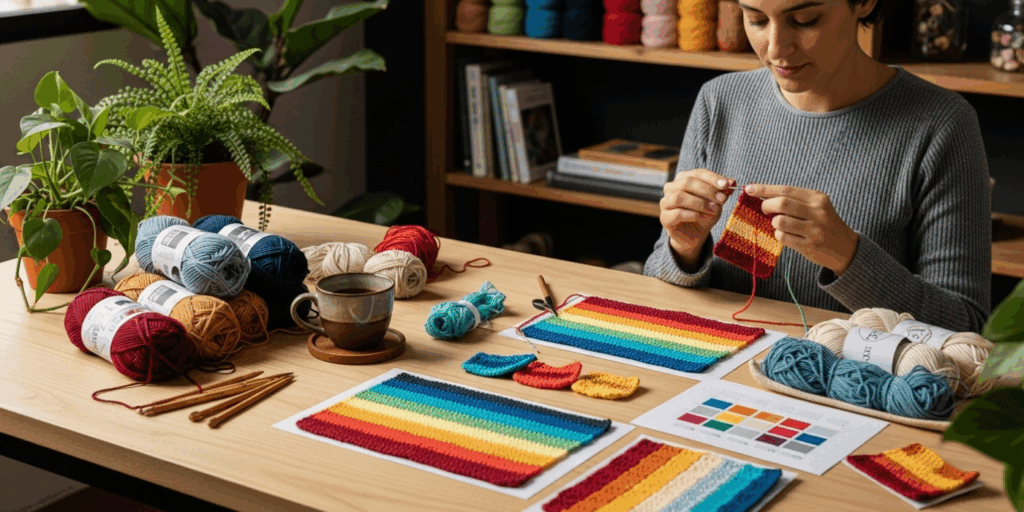
→ Fix: Begin with a 3-color stripe pattern. Just 10 rows. Then try a simple checkerboard. Build confidence before tackling a full-color portrait.
Mistake #5: Ignoring gauge
→ Fix: Make a small swatch. If your stitches are too tight, go up a hook size. If they’re loose, go down. Gauge makes or breaks colorwork.
Bonus tip: Use stitch markers. Place one at the beginning of each color change row. It’s like a little flag saying, “Hey, this is where the magic happens.”
And if you’re nervous? Practice on a dishcloth. Seriously. A colorful dishcloth is the perfect low-stakes playground. You’ll mess up? No big deal. You’ll learn? Big win.
The Joy of Making Something Only You Could Create
I’ll never forget the first time I finished a colorwork piece—a tiny owl pillow for my niece.
I’d spent three evenings wrestling with yarn, re-doing rows, and wondering if I’d ever get the eyes right. When I finally stitched the last seam and held it up… she screamed. Not because it was perfect. But because it was mine.
That’s the power of colorwork crochet. It’s not about perfection. It’s about presence.
Every time you switch colors, you’re making a choice. Red for love. Blue for calm. Yellow for joy. You’re not just crocheting—you’re embedding emotion into fabric.
And in a world where everything’s mass-produced, handmade colorwork is a quiet rebellion. It says: I took my time. I paid attention. I made this with care.
You don’t need to be an artist. You don’t need to follow a pattern exactly. Even a crooked heart or a slightly uneven stripe tells a story.
So start small. Try a 5-row striped coaster. Then a two-color bookmark. Then a hat with your dog’s name woven in.
Each piece is a step toward something bigger—not just in skill, but in confidence.
You’re not just learning a technique. You’re learning to trust yourself.
And that’s the most beautiful thing you’ll ever crochet.
Ready to Try It? Start With This Simple Project
Want to jump in right now? Here’s your starter project: The Colorful Coaster Set.
Materials:
- 4 colors of worsted-weight yarn (e.g., red, green, white, gray)
- Size I (5.5mm) crochet hook
- Scissors
- Yarn needle
Pattern:
- Chain 12.
- Row 1: Single crochet in 2nd chain from hook and across (11 sc). Turn.
- Row 2: Switch to color #2. Single crochet across. Turn.
- Row 3: Switch to color #3. Single crochet across. Turn.
- Row 4: Switch to color #4. Single crochet across. Turn.
- Repeat Rows 2–4 until you have 12 rows total.
- Fasten off. Weave in ends.
You’ve just made your first colorwork piece.
Now repeat it 4 times. Stack them. Gift them. Use them.
You didn’t need a tutorial. You didn’t need to be perfect. You just needed to begin.
And that’s all it takes.
Final Thoughts: Your Hands Know More Than You Think
Colorwork crochet isn’t about mastering complex stitches. It’s about trusting your hands.
It’s about the quiet rhythm of switching yarns. The satisfaction of seeing a pattern emerge stitch by stitch. The joy of someone saying, “Did you make this?”
You don’t need expensive tools. You don’t need years of practice. You just need a hook, some yarn, and the willingness to try.
So grab that leftover yarn from your last project. Pick a color combination that makes you smile. And start with just 10 stitches.
Because the world doesn’t need another mass-produced blanket.
It needs yours.
What will you make first? A blanket for a newborn? A hat for your partner? A bag that screams “me”?
I’d love to hear about it. Drop a comment below—I read every one. And if this guide helped you take your first step into colorwork, please share it with someone who’s been waiting to start.
Your next masterpiece? It’s just one hook, one stitch, one color change away.
Go make it.

Maria Santos is a dedicated crochet and knitting enthusiast who finds joy in turning simple strands of yarn into meaningful, handmade art. With a natural eye for detail and a deep love for fiber crafts, she brings warmth, creativity, and years of personal experience to every project. Maria is inspired by the stories woven into each stitch and loves sharing that passion with others.