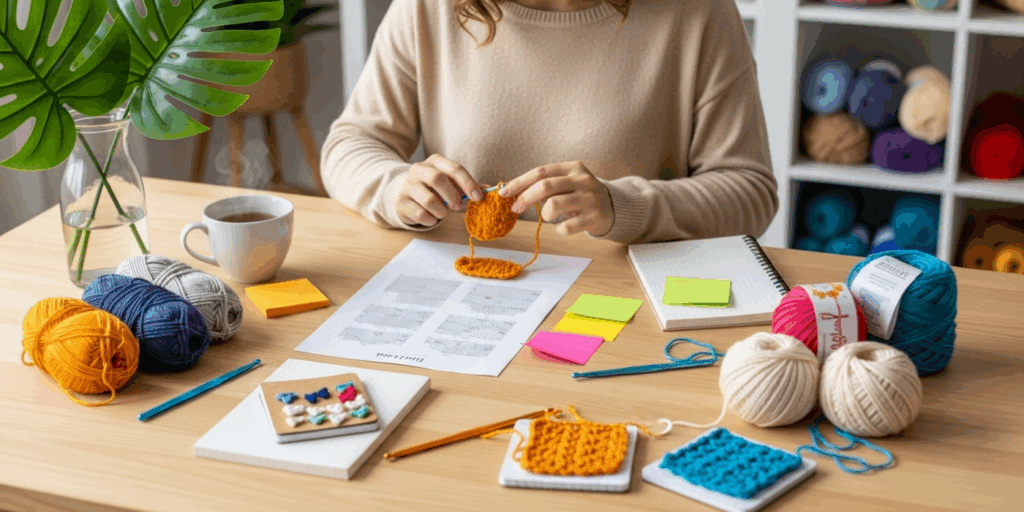
You’ve just bought your first hook, picked out the softest yarn, and watched a dozen YouTube tutorials. You’re ready to make that cozy blanket, adorable amigurumi, or stylish scarf… but then you open the pattern—and freeze.
“What does ‘sc2tog’ even mean?”
“Why is there a star next to this row?”
“Is this pattern written in English or ancient hieroglyphs?”
If this sounds familiar, you’re not alone. Thousands of new crocheters hit this wall every year—not because they lack skill, but because crochet patterns look like cryptic code. The good news? They’re not. And by the end of this guide, you’ll be reading them like a pro.
This isn’t about memorizing jargon. It’s about understanding the logic behind the symbols, abbreviations, and structure. Whether you’re holding a free pattern from a blog, a book from the library, or a paid design from Etsy, knowing how to read crochet patterns unlocks endless creativity. You’ll stop feeling lost—and start feeling confident.
In this guide, we’ll break down the basics step by step: how to decode common abbreviations, understand pattern structure, follow row-by-row instructions, interpret symbols and repeats, and avoid the most common beginner mistakes. We’ll also share real-life tips that will save you time, yarn, and frustration. By the end, you won’t just read patterns—you’ll enjoy them.
Let’s unravel the mystery—one stitch at a time.
Decoding the Alphabet: Common Abbreviations Made Simple
Imagine trying to cook from a recipe that uses only initials: “Mix 2 Tbsp. s. w/ 1 c. f.” Confusing, right? That’s what crochet patterns feel like without context. But once you learn the shorthand, it becomes second nature.
Here’s the truth: crochet abbreviations are designed to save space and speed things up. They’re not meant to confuse you—they’re meant to help you crochet faster once you know them.
Let’s start with the big ones:
- ch = chain
- sc = single crochet
- dc = double crochet
- hdc = half double crochet
- sl st = slip stitch
- st(s) = stitch(es)
- rep = repeat
- rnd = round
- beg = beginning
You’ll see these in almost every pattern. And guess what? You don’t need to memorize them all at once. Keep a cheat sheet taped to your desk or saved on your phone. Even experienced crocheters do.
Here’s a real example:
“Row 1: ch 15, sc in 2nd ch from hook and in each ch across. (14 sc)”
Break it down:
- Chain 15 stitches.
- Skip the first chain (this is standard—it acts as your turning chain).
- Single crochet into the second chain from your hook.
- Continue sc in each remaining chain.
- You should end up with 14 stitches total (because you skipped one).
See? It’s just a sequence of actions. No magic, no mystery.
Pro Tip: Bookmark a reliable abbreviations chart (like the one from the Craft Yarn Council) and refer to it often. Print it. Stick it on your mirror. Use it until you don’t need it anymore.
And here’s the secret: most patterns use the same abbreviations. Once you learn “sc,” “dc,” and “ch,” you’ve already unlocked 80% of beginner patterns. The rest is just arranging those stitches in different ways.
You’re not learning a language—you’re learning a system. And systems? They’re meant to be figured out.
Understanding Pattern Structure: The Blueprint Behind the Magic
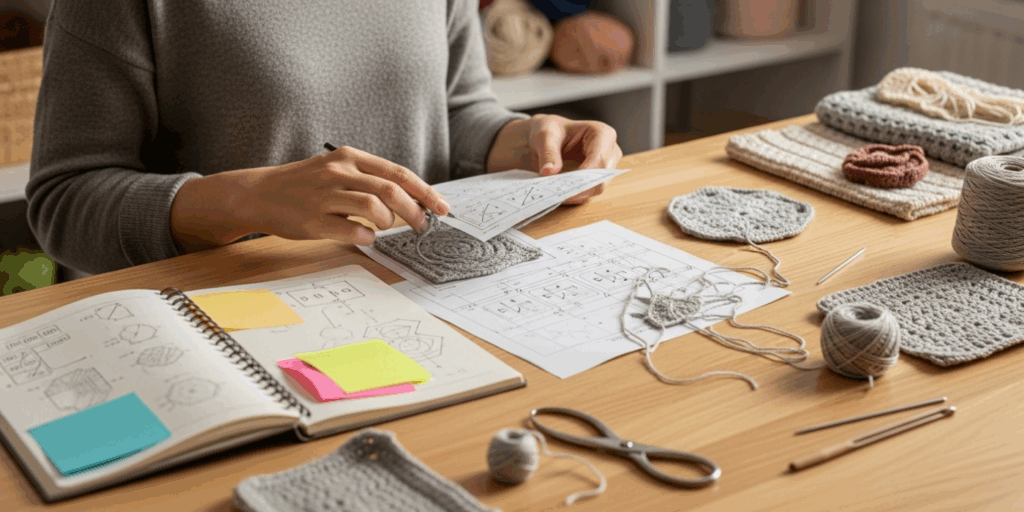
Think of a crochet pattern like a recipe for a cake. You wouldn’t start baking without knowing the ingredients, measurements, and steps, right? The same goes for crochet.
A well-written pattern has four key parts:
- Materials List
- Gauge
- Instructions
- Finishing Notes
Let’s unpack them.
1. Materials List
This tells you exactly what you need: yarn weight (like “worsted weight”), hook size (e.g., “5.0 mm”), scissors, tapestry needle, stitch markers, etc. Don’t skip this! Using the wrong hook or yarn can change the entire size and drape of your project. A pattern written for bulky yarn on a 6.5 mm hook won’t work if you use lace-weight yarn on a 3.5 mm hook. It’s like using sugar instead of flour in a cake.
2. Gauge
This is the most overlooked part—and the #1 reason beginners end up with a hat that’s too big or a blanket that’s too small.
Gauge tells you how many stitches and rows fit into a 4-inch square. Example: “16 sc and 20 rows = 4 inches.”
Why does this matter? Because everyone crochets differently. One person’s “tight” is another’s “loose.” If your gauge doesn’t match, your finished piece won’t fit right—even if you followed every stitch.
Simple fix? Make a swatch. Chain 20, work 20 rows in the stitch specified, then measure. If it’s too small, go up a hook size. Too big? Go down. Keep adjusting until you match the gauge. It takes 15 minutes—but it saves you hours (and yarn) later.
3. Instructions
This is the heart of the pattern. It’s broken into rows, rounds, or sections. You’ll see things like:
Rnd 1: Ch 4, join with sl st to form ring. 6 sc in ring. (6)
Rnd 2: Ch 1, 2 sc in each st around. (12)
Notice the number in parentheses? That’s your stitch count. It’s your checkpoint. Always check it at the end of each row or round. If it doesn’t match, you made a mistake—and it’s easier to fix now than after 10 rows.
4. Finishing Notes
This includes weaving in ends, blocking, sewing pieces together, or adding embellishments. Don’t rush this part—it’s what turns a messy project into a polished one.
Real-life analogy: Think of a pattern like a GPS route. The materials are your car and fuel. Gauge is your speed setting. Instructions are the turn-by-turn directions. Finishing notes are parking and locking the doors. Skip any part, and you might end up lost—or with a car that won’t start.
Understanding structure turns confusion into confidence.
Following Rows, Rounds, and Repeats: No More Guesswork
One of the most intimidating parts of a pattern? When it says:
“Rep from * to ** 3 more times.”
Or worse:
“Work even in st pattern until piece measures 8 inches.”
What does that even mean?
Let’s break it down.
Rows vs. Rounds
- Rows = you turn your work at the end of each line (like knitting). Flat projects like scarves, blankets, and dishcloths are usually worked in rows.
- Rounds = you work in a continuous spiral or join each round (like making a hat or amigurumi). You don’t turn.
Knowing which you’re doing changes how you count stitches and where you start.
Repeats: Your Secret Weapon
Patterns use repeats to avoid writing the same thing 20 times. Look for asterisks (*) or brackets [ ].
Example:
“sc in next st, dc in next st; rep from * to * across.”
This means:
Do “sc in next st, dc in next st” — then repeat that pair all the way across.
It’s like singing a chorus in a song. You don’t sing the whole thing each time—you just repeat the catchy part.
“Work Even” Explained
This phrase means: Keep doing the same stitch pattern you’ve been doing—don’t increase or decrease. So if you’ve been alternating sc and dc, keep doing that. If you’ve been working all sc, keep working all sc. No changes.
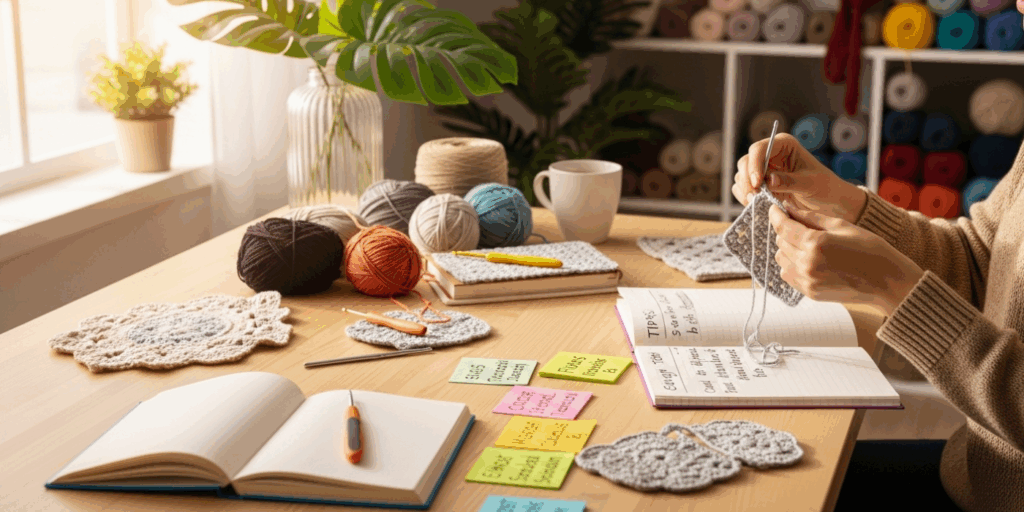
Pro Tip: Use highlighters or colored pens. Highlight the repeat section. Circle your stitch count. Draw arrows to show where you are in the row. Visual cues make patterns way easier to follow.
I once watched a beginner cry because she thought she “broke” her pattern after 12 rows. She hadn’t. She just missed one stitch in a repeat. With a simple stitch marker and a quick count, she fixed it in 2 minutes.
You can do this too.
Symbols, Charts, and Visual Cues: When Pictures Speak Louder Than Words
Not all patterns use words. Some use charts—tiny grids with symbols that represent stitches.
Looks intimidating? It’s not.
Think of it like a color-by-number painting. Each symbol = one stitch. A dot might mean a single crochet. A T-shape might mean a double crochet. A little circle? That’s a chain.
Here’s the magic: charts show you the shape of your project. You can see where increases happen, where curves form, where lace opens up. It’s like watching a blueprint come to life.
Many amigurumi patterns, doilies, and intricate lace designs use charts because they’re clearer than text.
But here’s the best part: you don’t need to read them perfectly to start.
Try this:
- Find a simple chart (many free beginner patterns include one).
- Match each symbol to its abbreviation on the key (it’s always provided).
- Work one row slowly, checking the symbol against your hook.
You’ll be surprised how fast your brain starts translating symbols into stitches.
Bonus: If you’re visually oriented (and many of us are), charts can be easier than written instructions. You’re not reading sentences—you’re following a map.
And if you’re ever stuck? Flip your phone sideways. Rotate the chart. Zoom in. Use a magnifying app. There’s no shame in using tools to help you see clearly.
Patterns are meant to serve you—not confuse you.
Avoiding the Top 5 Beginner Mistakes (And How to Fix Them)
You’ve learned the abbreviations. You understand the structure. You’re following the repeats. So why are you still making mistakes?
Here are the five most common errors—and how to dodge them:
- Skipping the First Stitch
“Why does my edge look crooked?”
→ Most patterns tell you to skip the first chain after chaining. That chain is your turning chain. If you crochet into it, you’ll add an extra stitch every row—and your piece will angle outward. Always check: “Chain 1, skip first chain” = you’re good. - Not Counting Stitches
“I swear I did 10, but now I have 12!”
→ Always count at the end of each row. If your count is off, go back immediately. One missed increase can throw off your whole project. - Ignoring Gauge
We said it before—but it’s worth repeating. A scarf might be forgiving. A sweater? Not so much.
→ Make a swatch. Always. - Using the Wrong Hook Size
Just because the pattern says “5.0 mm” doesn’t mean that’s your perfect hook. Everyone’s tension is different.
→ Use the hook size as a starting point. Adjust based on your gauge. - Giving Up Too Soon
“It doesn’t look like the picture!”
→ Your first project won’t be perfect. And that’s okay. Crochet is a skill, not a talent. Every expert was once a beginner who kept going.
Your new mantra:
“Count. Check. Adjust. Repeat.”
You’re not trying to be perfect. You’re trying to learn.
And every mistake? It’s just data. A clue. A chance to get better.
Your First Pattern: A Step-by-Step Walkthrough
Let’s put it all together.
Imagine you’ve chosen a simple beginner pattern: “Easy Granny Square.”
Here’s how you’d approach it:
- Read the materials: Worsted yarn, 5.0 mm hook. Grab yours.
- Check the gauge: Chain 10, work 5 rows of dc. Measure. 4 inches? Perfect.
- Start row 1: Chain 4, join with sl st to make a ring.
- Row 2: Chain 3 (counts as first dc), 2 dc in ring. Chain 2, 3 dc in ring. Repeat 2 more times. Join with sl st to top of ch-3.
→ You’ve made 4 clusters, each separated by a chain-2 space. - Count your stitches: 12 dc + 4 ch-2 spaces. Matches the pattern? Yes.
- Move to row 3: Follow the same logic.
- Finish: Fasten off, weave in ends.
You did it.
No magic. No genius. Just patience, attention, and a little courage.
That’s all it takes.
Final Thoughts: You’re Not Just Crocheting—You’re Learning to Trust Yourself
Reading crochet patterns isn’t about being perfect. It’s about being curious. It’s about asking, “What does this mean?” instead of “I can’t do this.”
Every crocheter who’s ever made a mistake, ripped out a row, or stared at a pattern in confusion has been right where you are.
And they kept going.
Because crochet isn’t just about yarn and hooks. It’s about resilience. About showing up—even when it feels confusing. About trusting that if you take one small step, the next one will appear.
You don’t need to memorize every abbreviation.
You don’t need to be fast.
You don’t need to make something Instagram-perfect.
You just need to begin.
So pick up your hook. Open your pattern. Take a deep breath.
And start with one stitch.
Then another.
And another.
Before you know it, you’ll be reading patterns like poetry—beautiful, rhythmic, and full of possibility.
And when you finish your first project?
You won’t just have a blanket, a hat, or a bunny.
You’ll have proof:
You learned how to read the invisible language of crochet… and you made something beautiful with your own hands.
Now it’s your turn.
What’s the first pattern you’re going to try?
Have you ever felt stuck reading a pattern? What confused you the most?
Drop a comment below—I read every one. Let’s build a community where no beginner feels alone.
And if this guide helped you, share it with a friend who’s just starting out. Sometimes, the best gift you can give is the confidence to begin.
Happy crocheting.
Your next masterpiece is waiting—just one stitch away.
Maria Santos is a dedicated crochet and knitting enthusiast who finds joy in turning simple strands of yarn into meaningful, handmade art. With a natural eye for detail and a deep love for fiber crafts, she brings warmth, creativity, and years of personal experience to every project. Maria is inspired by the stories woven into each stitch and loves sharing that passion with others.